Voice-to-Task AI: Reducing Detection Mistakes
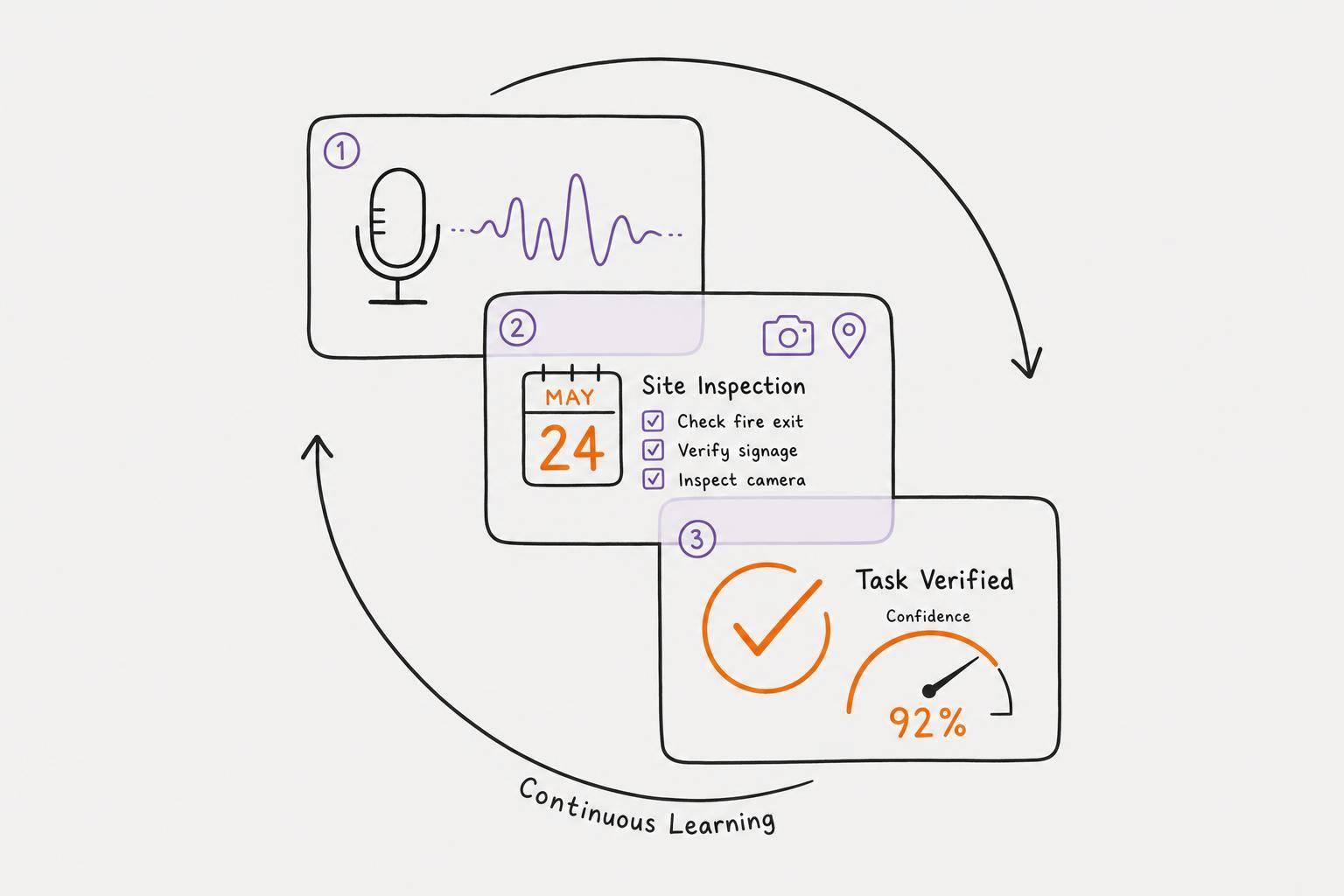
A voice tool can hear you right and still turn your words into the wrong task. That is the core issue: transcript accuracy is not the same as task accuracy.
If I boil this article down, the message is simple:
- The main failure is detection, not just transcription
- Most mistakes fall into 3 groups: wrong meaning, wrong task split, and wrong date
- The best fixes are: more context, confidence checks, and learning from past mistakes
- The metric that matters most is: whether the final task is correct, not just whether the words were transcribed well
A few numbers make the point fast:
- Speaking can take 2–4 seconds, while switching to typing can take 6–10 seconds
- Multimodal systems cut error rates by 38.9% vs. text-only setups
- Confidence-driven checks improved task performance by 17%
- Some systems reached 84.5% task-parsing accuracy with added context
- Task-owner detection lands around 85%, which still leaves room for wrong assignments
If I were summarizing the article for a busy reader, I’d say this:
| Problem | What goes wrong | What helps |
|---|---|---|
| Meaning errors | A small miss, like dropping “not,” flips intent | Audio + text + decoder signals |
| Boundary errors | One task gets split, or two tasks get merged | Better pause handling and context |
| Timing errors | “Next Friday” or a correction gets mapped wrong | Calendar checks and confirmation loops |
Bottom line: if you want voice-to-task AI to feel useful, you have to judge it by whether it creates the right task, owner, and due date with little cleanup. That matters even more for people using ADHD task management apps, because every wrong task adds another mental step.
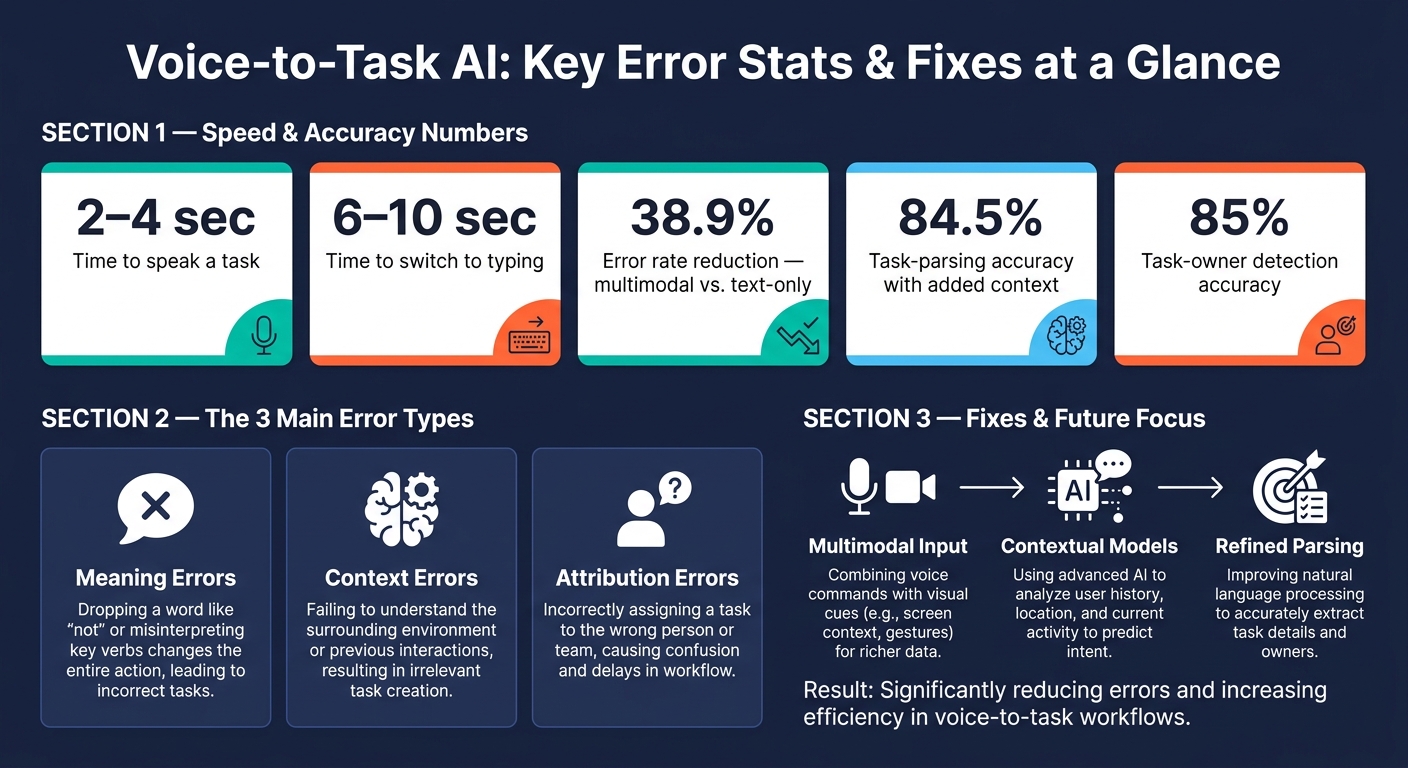
Voice-to-Task AI: Key Error Stats & Fixes at a Glance
Common task-detection mistakes in voice AI
Voice-to-task errors usually fall into three buckets: misheard words, broken task boundaries, and bad timing.
Speech recognition errors that change task meaning
Background noise can knock out a short word like "not", turning "do not remind me" into "do remind me". That flips the meaning of the task, even if the transcript looks close enough at a glance.
Domain-specific terms are another problem. Systems often swap unfamiliar words for similar-sounding ones - a medication name like "Lisinopril" might become "listen a pearl". That doesn't just make the transcript messy. It creates the wrong task. Numbers can break in the same way: "twenty-five thirty" could be read as $25.30 or $2,530, depending on context the system failed to catch.
WER stays low on clean audio, but it climbs fast with accents and domain-specific terms.
Task boundary and intent errors in conversational speech
Timing mistakes often split one idea into two tasks. People pause, restart, and tack on context in the middle of a sentence. A natural pause of about 600 ms can be treated like the end of a turn, which cuts the task off before the speaker is done. This early cutoff is a common speech-end detection failure. The reverse happens too: separate instructions in one utterance can get merged into one task.
Intent mistakes make this worse. A casual observation like "I noticed we ship too many tickets on Fridays" can be marked as an action item instead of a reflection. Put simply, the system doesn't always know whether someone is pointing something out or saying they plan to do something.
Missing, duplicated, and incorrectly timed tasks
After a task is captured, timing is still a weak spot. If a system stops too soon or gets a sentence boundary wrong, part of a spoken note may be dropped. A correction like "actually, make that next Monday" can be treated as a brand-new task instead of an update to the last one.
Date handling is another common failure point. Relative dates like "next Friday" are often mapped to the wrong calendar date, or shortened to just "Friday" without the week context. That kind of mistake forces manual checking and adds cognitive load. For users managing neurodivergent traits, these errors make it harder to stay organized with ADHD using digital tools.
sbb-itb-1b3be24
Why voice-to-task systems misread spoken instructions
A lot of errors happen after transcription. The words may look close enough on the page, but the system still misses the user's intent, timing, or the link between people, objects, and actions. In plain English: the problem often isn't just hearing the speech. It's understanding what the speaker meant to do. The main reasons are acoustic distortion, missing context, and weak domain coverage.
Noise, accent variation, and fast speaking styles
Speech models do well with clean audio. But once you add accents, background noise, or domain-specific terms, task-detection errors go up. And sometimes one tiny miss changes everything. If the system drops a single negation, it can flip the meaning of the task entirely.
Fast speech makes this worse. So does disfluent speech. Words may get added, skipped, or blurred together before task parsing even starts. By the time the system tries to figure out the action, it's already working from shaky input.
Ambiguous phrasing and missing context
Some requests fail because the phrasing is too loose for the system to resolve on its own. A line like "remind me about that tomorrow" sounds clear to a person in the moment, but a system can stall if it can't tell what "that" points to.
Time references create another problem. Relative dates depend on the current time and timezone, which means the same phrase can land on the wrong day or the wrong hour if that context isn't handled correctly. On top of that, the system has to tell the difference between a real task and a passing comment. If it can't, casual remarks turn into to-dos, while actual tasks slip through the cracks.
That gets to the heart of the issue: task detection can't rely on transcript text alone. It also needs semantic checks and timing checks.
Vocabulary gaps and weak domain tuning
When context doesn't clear things up, vocabulary becomes the next weak spot. General-purpose speech models often miss specialized terms. Instead, they may replace them with similar-sounding words or route the request into the wrong class.
Even when the transcript itself is correct, another problem can show up: the system may lose track of which entity belongs to which instruction. That's a big deal. A task isn't just an action; it's also who, what, and when. If those links break, the output may sound fine but still be wrong.
There's also a model-level issue here. Encoder compression can blur word boundaries and strip away details the system needs for task extraction. So the failure isn't always obvious. Sometimes the transcript looks okay, but the structure needed to turn speech into the right task has already been thinned out.
Research-backed methods for reducing detection mistakes
Research points to three main fixes: multimodal signals, uncertainty checks, and model adaptation. Each one helps the model recover context it would otherwise miss.
Combining speech signals with semantic context
Research shows that multimodal systems beat single-signal models. When models combine audio waveforms, transcript text, and ASR decoder signals, including confidence scores and decoding signals, they perform much better than systems that rely on just one input stream. In one study, this setup improved error rate by 38.9% over text-only models and by 20.5% over audio-only models. Adding ASR decoder signals and extra text data also led to a 6.9% relative improvement in detection accuracy.
This makes intuitive sense. A spoken command isn’t just sound. It also carries meaning, timing, and often a situational clue that only shows up when the system looks at the full picture.
Studies that include on-screen and conversational context also do a better job of resolving references and identifying task boundaries. GptVoiceTasker reached 84.5% accuracy in parsing spoken commands into executable actions by using contextual information and on-screen content. The same idea carries over to uncertainty checks and retraining: more context usually means fewer wrong guesses.
Confidence-based checks and confirmation loops
When confidence drops, the system should pause and ask before writing a task. Systems use entropy-based confidence measures to decide when to trigger a clarification loop instead of creating a task silently. Failure-specific diagnostics then split perception failures from understanding failures, which lets the system ask sharper follow-up questions.
That split matters. Different failure modes need different recovery steps:
- Acoustic failures need repeat prompts
- Linguistic failures need clarification prompts
A generic “repeat that” prompt won’t fix an out-of-vocabulary word. It treats every miss the same way, even when the cause is different.
That kind of diagnostic precision led to up to a 30% reduction in Word Error Rate and a 17% improvement in task performance across diverse accents, distortions, and domains. Deletion detectors, which catch speech content the decoder missed, reached a 92.42% recall rate on deletion errors, a failure type that standard entropy-based confidence scores usually miss.
Retraining from failed outputs and usage patterns
Once live failures are logged, the model can learn from them. That’s how systems get better at repeated misheard terms, timing errors, and command patterns. Learning from historical user command sequences helped GptVoiceTasker improve task execution efficiency by 34.85%.
Low-Rank Adaptation (LoRA) gives teams another efficient route. By updating just 0.84% of the model’s parameters, LoRA adapts task detection to specialized command patterns with minimal retraining.
Multimodal fusion improves accuracy, confidence checks cut down bad captures, and retraining helps the system adjust to how people actually speak.
How studies measure task extraction accuracy and what it means for ADHD-friendly planning
Why task-level metrics matter more than transcript quality
Once detection errors drop, the next issue is simpler to state and harder to solve: did the system pull out the right task?
A lot of people assume that if a voice tool gets the words right, the job is done. It’s not. A transcript with 95% word accuracy can still produce the wrong task if the system misreads intent or misses a due date. And the opposite can happen too: a transcript that’s a little messy can still turn into a useful task if the routing logic makes the right call.
That’s why researchers test voice-to-task systems on more than one layer. WER tells you how well the system transcribed speech. It does not tell you whether the final task is correct. So studies score task extraction separately from transcript quality.
The metrics that matter most sit at the task-routing layer:
| Metric | What It Measures | Why It Matters |
|---|---|---|
| Intent Accuracy | Measures whether the system captures real commitments, not suggestions | Separates actionable tasks from hypothetical speech |
| Project Assignment | Filing tasks into the right category | 80% to 90% accuracy for 5 to 30 existing projects |
| Who owns the task | Identifying the task owner | About 85% accuracy, with wrong guesses about 15% of the time |
| Non-task speech captured as a task | Non-actionable speech captured as tasks | Multitask learning that includes noise classification improves performance in noisy settings |
The biggest problem usually isn’t a typo or a missed word. It’s when something like "we should probably look into this" gets stored as an actual commitment. That kind of bad auto-routing makes people double-check every task, and trust starts to slip.
What the evidence means for less mentally taxing planning
For people planning their day with ADHD, a misrouted task isn’t a small annoyance. Every fix means another context switch, another reread, and another manual edit.
Voice capture can cut input time. But if the user has to clean up a pile of mistakes later, that time savings disappears. Keeping the raw transcript next to the parsed task helps people recover from errors. And when the system isn’t sure, it’s often better to leave the item in an inbox for later review instead of filing it too early.
Calma uses voice capture, smart prioritization, and automatic due-date detection to keep capture fast and cleanup minimal.
Conclusion: Key findings on reducing voice-to-task errors
The main takeaway is simple: judge voice-to-task systems by task-level accuracy, not transcript quality. Studies cut errors by combining speech signals with semantic context, adding confidence checks and confirmation loops, and using deterministic rules for explicit dates before passing text to higher-level interpretation. Researchers also stress keeping the raw transcript and checking calendar context when deadlines are vague.
Success at the task level - not just the transcript level - is what makes a system feel dependable instead of annoying. For ADHD-friendly planning, less rechecking means lower cognitive load.
FAQs
Why isn’t accurate transcription enough?
Accurate transcription isn’t enough. Text on its own doesn’t give you structure or clear next steps.
Raw transcripts usually come with filler words, repeated ideas, and several tasks jammed into the same note. So even after the audio is turned into text, someone still has to clean it up by hand.
Without an intelligent routing layer, those notes stay as scattered text instead of turning into ranked tasks, due dates, or project buckets. And that pulls people right back to a screen and keyboard, which clashes with a voice-first workflow.
What task errors happen most often?
The most common task errors in voice-to-task systems usually come from two places: transcription and intent recognition.
That shows up in a few familiar ways:
- Silent mistranscriptions
- Dropped function words caused by background noise
- Accent-related errors
- Trouble recognizing names or specialized terms
Another common problem is premature turn-ending. That happens when the AI treats a short pause like the user is done speaking and cuts them off in the middle of a sentence.
How can voice-to-task AI reduce wrong dates and assignments?
Voice-to-task AI cuts date and assignment mistakes by using deterministic rules to read phrases like “tomorrow” or “next Friday” from the user’s local time and time zone, instead of leaning only on language models.
It also stores canonical mappings for people or items and uses confidence-aware routing. So if a task is unclear, it stays in an inbox for manual review instead of getting filed in the wrong place.