How AI Simplifies Task Navigation for ADHD
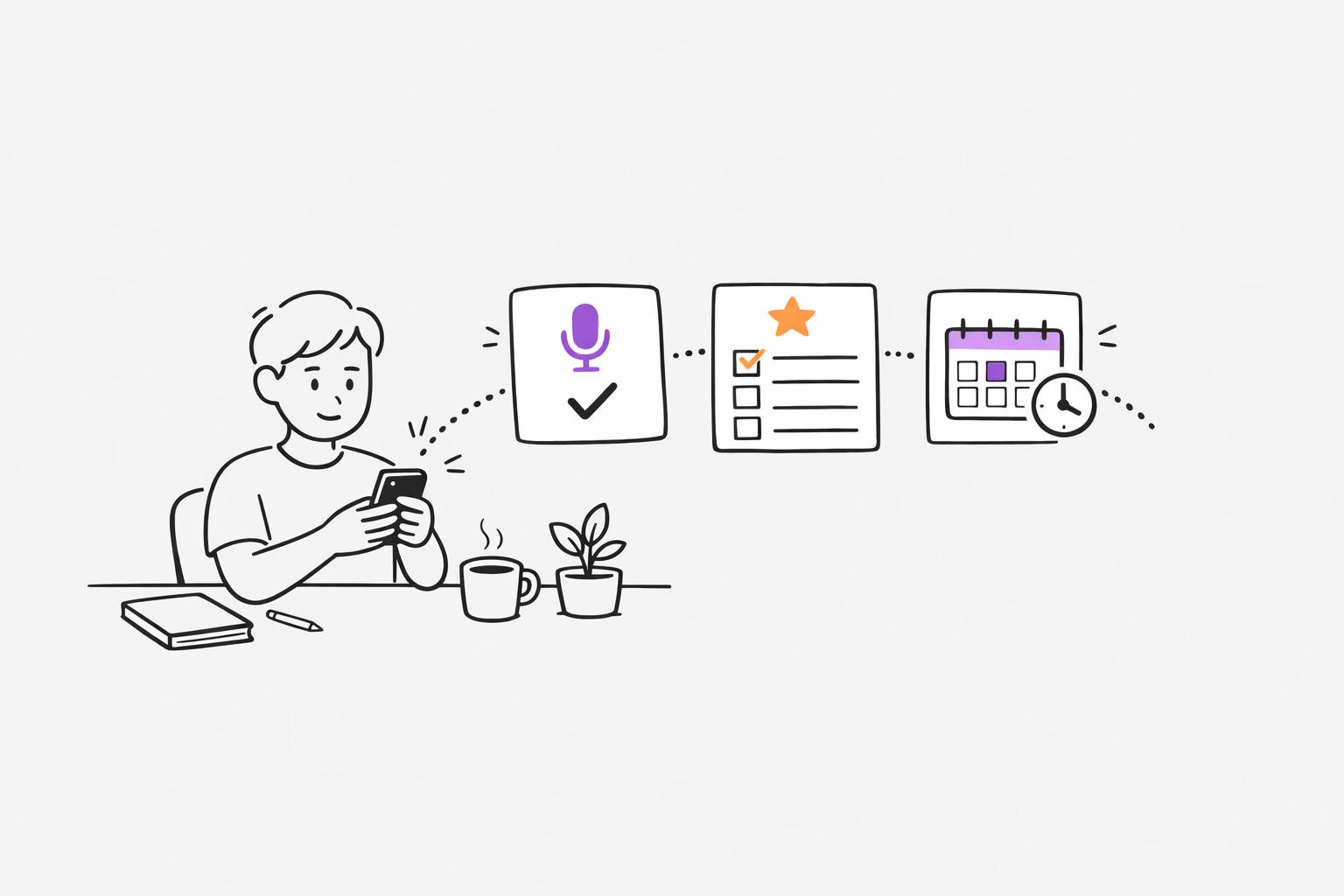
Managing tasks with ADHD is tough - prioritizing, starting, and staying on track with ADHD productivity planner app options can feel overwhelming. AI tools like Calma are changing that by offering ADHD task management apps tailored to your brain. From voice-to-task conversion to smart prioritization, these tools reduce the mental load, helping users focus on action instead of planning.
Key Highlights:
- Voice Input: Quickly convert thoughts into tasks, reducing the risk of forgetting ideas.
- Smart Prioritization: AI organizes tasks by urgency and mental energy, easing decision fatigue.
- Automatic Deadlines: Detects time-related phrases and sets due dates automatically.
Calma, specifically designed for ADHD, combines these features with habit tracking and emotion monitoring to help users stay productive and aware of their progress. It’s available for free with optional paid features starting at $2 per week or $39.99 annually.
ADHD and Task Navigation Challenges
How ADHD Affects Task Management
ADHD disrupts the brain's executive functions, which are essential for planning and carrying out tasks. This is why Dr. Russell Barkley, a neuropsychologist, refers to ADHD as "a disorder of 'doing what you know,' not one of knowledge". Essentially, people with ADHD often know what needs to be done but struggle to bridge the gap between understanding and action.
For children with ADHD, nearly 90% face difficulties with executive functioning, and as they grow into adulthood, starting tasks becomes even harder. This is because mundane activities often fail to generate enough dopamine, the brain chemical that fuels motivation. Dr. Karen Wilson, a clinical neuropsychologist, explains: "Individuals with ADHD may have a hard time managing their responses to everyday demands, becoming overwhelmed by even basic tasks". Without the dopamine boost that comes from rewarding activities, motivation can stall entirely for tasks that feel unrewarding.
Take something as simple as cleaning the kitchen. For someone with ADHD, this involves dozens of small decisions, like deciding where to begin or what order to follow. This process can feel so overwhelming that it leads to a "freeze response", where the brain essentially shuts down instead of choosing a starting point. Switching between tasks adds another layer of difficulty. Research shows that every time a person with ADHD shifts focus, it can take 15 to 20 minutes to mentally reset and reorient.
These obstacles make everyday task management particularly challenging and create navigation problems that affect daily life.
Common Task Navigation Problems
Beyond executive dysfunction, ADHD introduces specific challenges that make managing tasks even harder. One of the most disruptive issues is time perception. People with ADHD often experience time as either "now" or "not now," which makes future deadlines feel irrelevant until they become urgent crises. This "time blindness" leads to chronic underestimation of how long tasks will take, resulting in missed deadlines and last-minute scrambles.
Disorganized to-do lists also add to the chaos. When every task feels equally important, the internal decision-making system can break down, leading to decision paralysis. Mikayla Phan from ADHD Solutions, LLC, explains: "The difficulty is not a lack of motivation or understanding. It is the challenge of organizing multiple internal and external variables at the same time". On top of this, working memory issues make it easy to forget what you were doing mid-task or to lose track of multi-step instructions.
Because ADHD brains often prioritize stimulation, novelty, or urgency over importance, crucial but boring tasks frequently get pushed aside. These patterns of behavior underline the need for tools that simplify task management and adapt to these unique challenges. Intuitive, AI-driven solutions could offer a way forward.
sbb-itb-1b3be24
5 Practical Ways to Use AI To Help with ADHD (from an ADHD Therapist in NYC)
How AI Simplifies Task Navigation for ADHD
AI offers practical solutions for managing the challenges of memory lapses and decision fatigue, common in ADHD. By capturing thoughts, organizing priorities, and tracking deadlines, it allows you to focus on completing tasks rather than juggling them. Here’s how AI tools make task management more manageable through voice input, intelligent prioritization, and deadline tracking.
Voice-to-Task Conversion
Using voice input to create tasks is fast - taking just 10–15 seconds, compared to 45–60 seconds for typing. This speed helps prevent memory lapses, a frequent hurdle for those with ADHD. Harold Meyer from ADDRC.org highlights the benefit:
"Verbal externalization reduces cognitive load on working memory, allowing you to process information more effectively".
Modern AI-powered dictation tools boast 99% accuracy in capturing spoken words. Speaking tasks aloud not only ensures they’re recorded but also serves as a mental nudge to begin working. You can even use verbal cues like "high priority" to help the AI sort tasks automatically.
Smart Prioritization
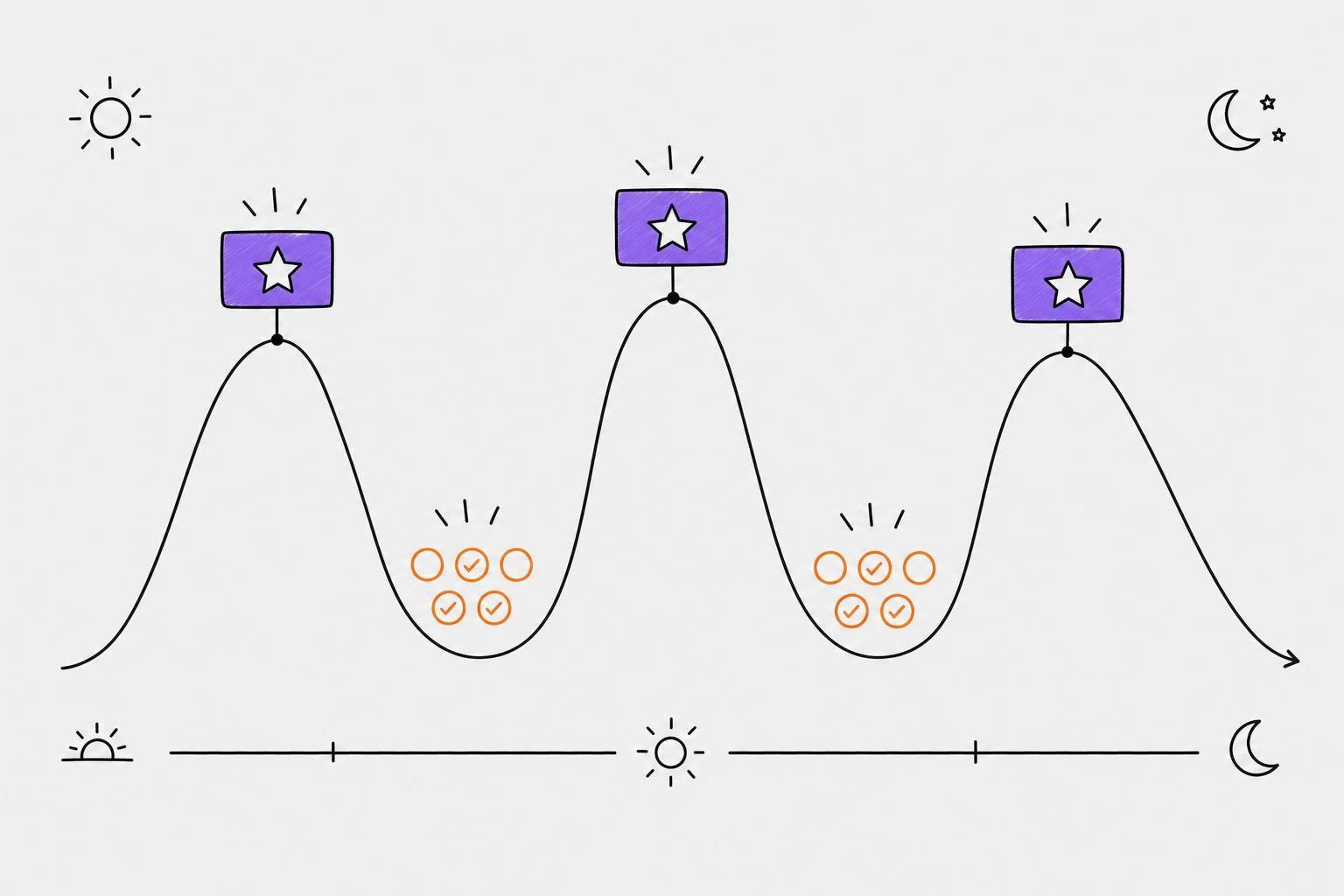
AI algorithms analyze factors like urgency, deadlines, and required mental energy to suggest which tasks to tackle first. This helps reduce the overwhelm of decision-making. Some tools can also group tasks by cognitive effort, making it easier to align work with your current energy levels. With priorities that adjust in real time as your schedule changes, you can focus on progress without constant reorganization. As Understood.org puts it:
"AI can be the support that adapts to your brain - instead of demanding that you adapt".
Automatic Due Date Detection
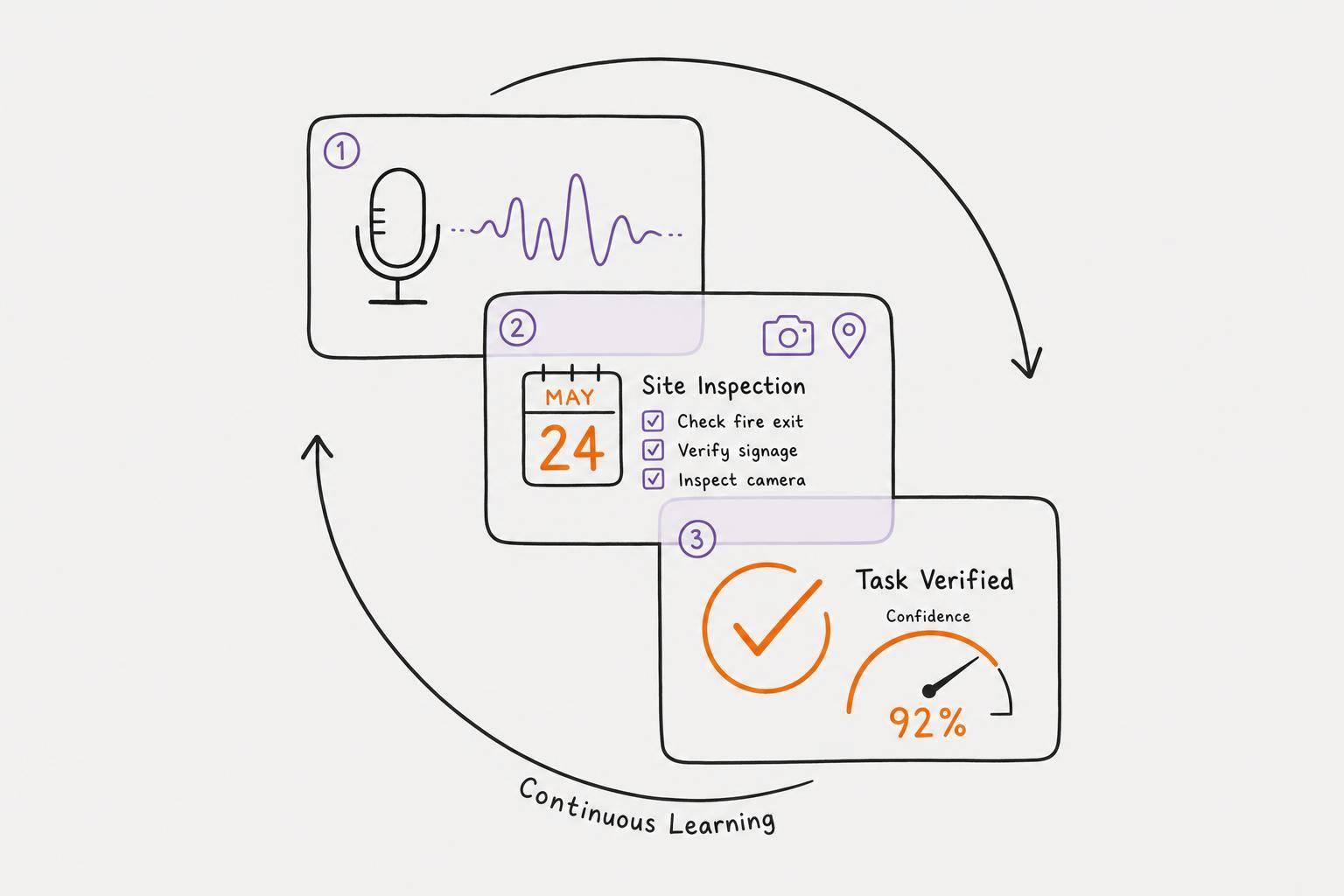
Natural language processing in AI tools picks up on time-related phrases like "by Friday" or "before the meeting next Tuesday" from your voice recordings. It then assigns deadlines automatically, removing the need for manual input. This automation simplifies task management and reduces the strain on executive function. Smart reminders tied to these deadlines ensure you stay on track without feeling overwhelmed.
How Calma Addresses ADHD Task Management Needs
Designed specifically with ADHD in mind, Calma simplifies task management by combining key AI features like voice-to-task conversion, smart prioritization, and automatic due date detection. Instead of making you conform to rigid systems, Calma adapts to how you naturally think. Its AI tools are built to ease the executive functioning challenges that come with ADHD. With a minimalist dark interface to minimize distractions and a voice-first design to eliminate the hassle of typing, Calma turns task management into a smoother, more intuitive process.
Voice-to-Task Conversion in Calma
Calma transforms your spoken thoughts into organized tasks in just 10–15 seconds, which is crucial for ADHD users whose working memory often fades quickly - sometimes within 30 to 60 seconds. All you have to do is open the app, speak, and let the AI handle the rest. This feature is designed to align with the way your brain naturally processes thoughts. As freelance designer Sarah M. shares:
"I've spent years buying paper planners I never use. Calma is the first tool that actually works with my ADHD, not against it. Being able to just talk and have the AI sort my messy brain dump into tasks is life-changing."
To ensure privacy, Calma processes voice recordings either on-device or through secure APIs, without storing raw audio permanently. This guarantees quick and secure task capturing.
Smart Prioritization and Navigation in Calma
Calma’s AI takes the burden of decision-making off your shoulders by automatically sorting tasks, assigning due dates, and structuring your day with ADHD. The daily planner view lays out your tasks clearly, while the visual habit grids provide instant feedback on your progress. Marcus L., a software engineer, highlights the app's focus-friendly design:
"The dark, minimalist interface is exactly what I need to stay focused. I love the pixel habit grid - it gives me that quick dopamine hit to keep my streaks going."
As of March 2026, Calma boasts a perfect 5.0/5 rating on the App Store, based on 4 user reviews.
Emotion Tracking and Habit Progress Visualization
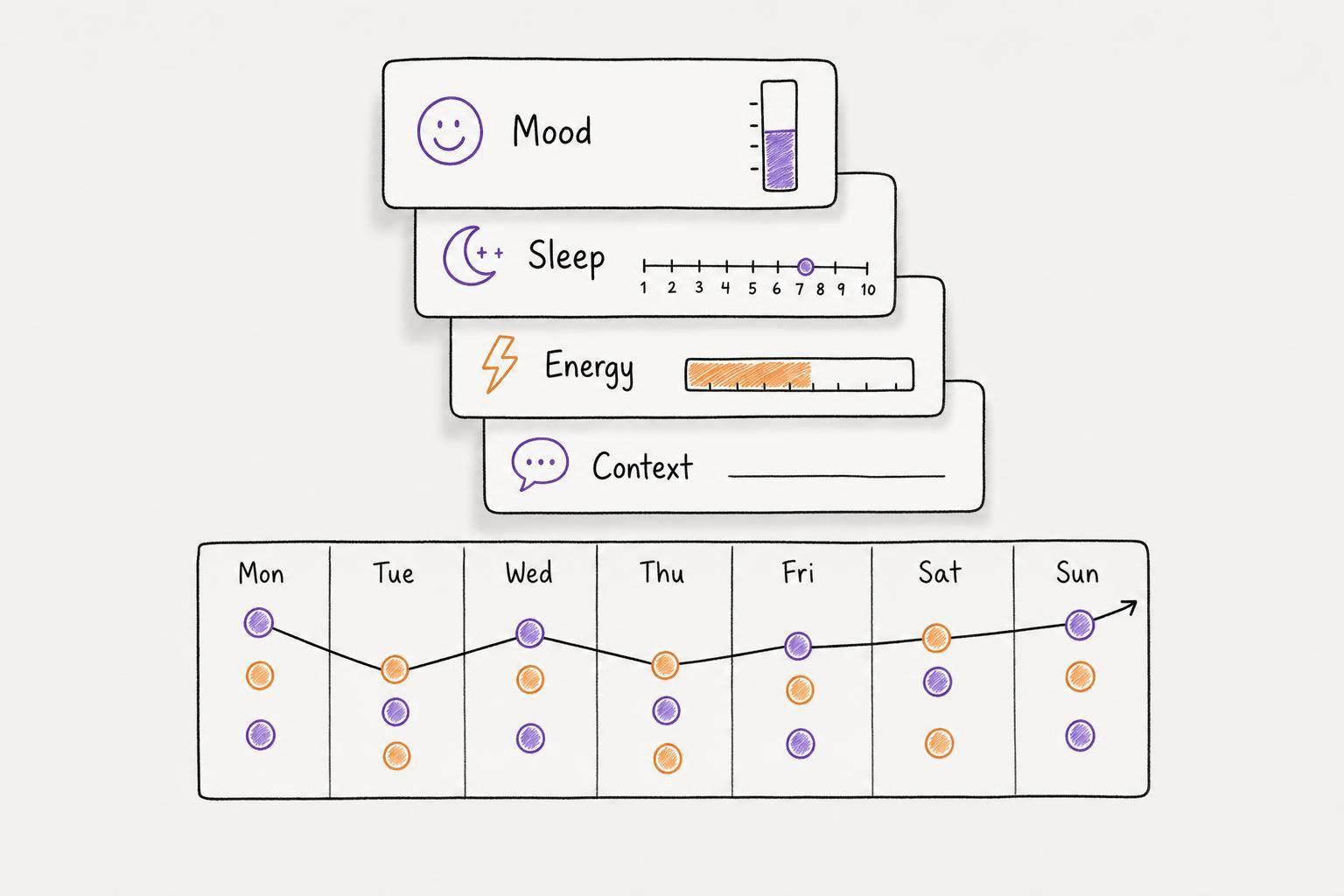
Calma goes beyond task management by helping you monitor your emotional state and track habits, creating a well-rounded productivity tool. Its AI-driven journaling feature detects emotions from your voice entries, allowing you to see how your mood impacts your productivity without needing to track it manually. Meanwhile, the visual habit grids turn your goals into tangible progress markers, showing how far you’ve come each day. By combining emotion tracking with habit visualization, Calma offers valuable insights into how emotional shifts influence your ability to stick to routines - an area that can be especially tricky for those managing ADHD.
Calma Pricing and Plans
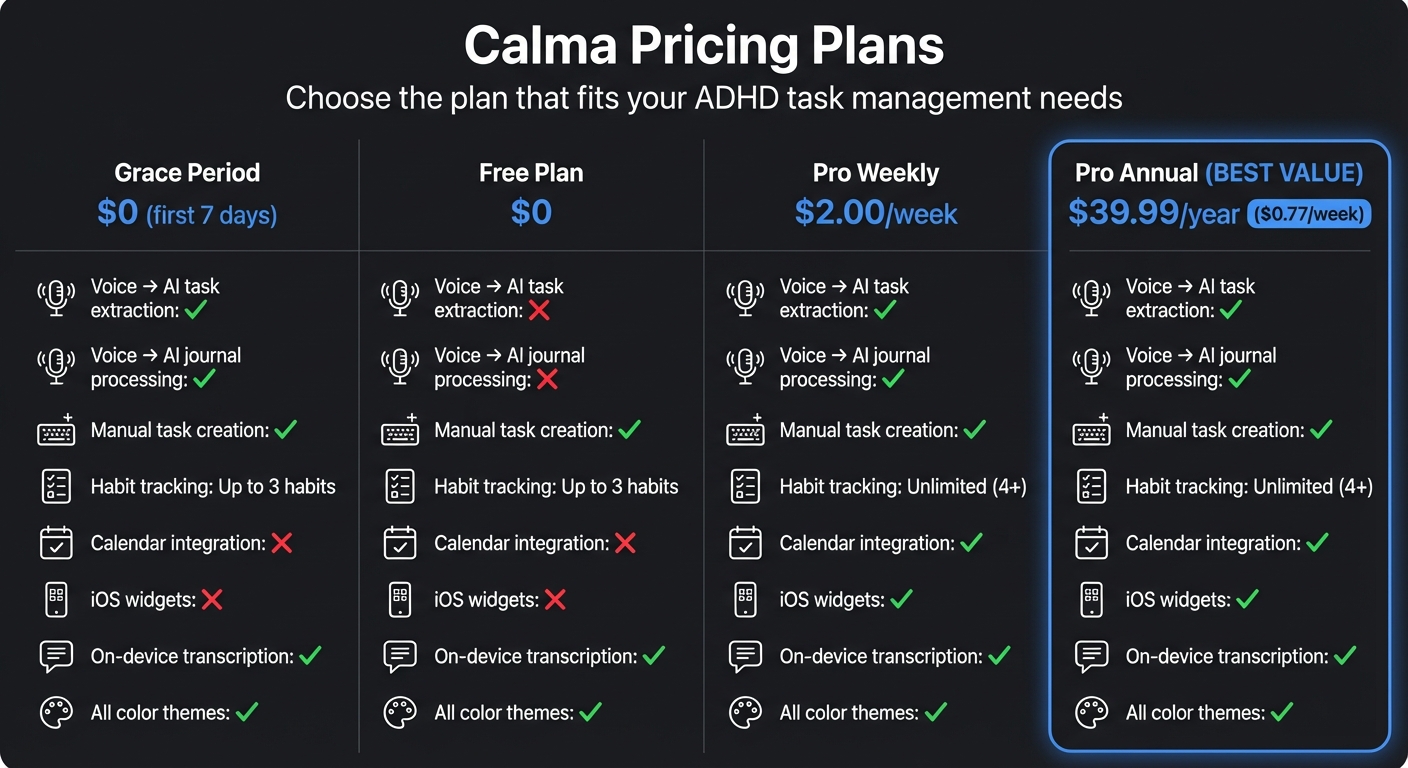
Calma Pricing Plans Comparison for ADHD Task Management
Calma keeps things simple with its pricing, making it easy to explore the app's core features without any upfront commitment. You can download it for free from the Apple App Store and start using it right away. The pricing structure is designed to help individuals with ADHD see how AI-driven task management can complement their needs.
Available Plans
When you first install Calma, you’ll get a 7-day Grace Period at no cost. During this time, you can try out key AI features like voice-to-task conversion and voice-to-journal processing, along with manual task creation, habit tracking (up to 3 habits), on-device transcription, and access to all color themes. While features like calendar integration, iOS widgets, and tracking more than 3 habits are not included in this trial, it’s enough to understand how the app’s voice AI features can fit into your routine.
Once the grace period ends, the Free Plan kicks in, still at no cost. It includes manual task creation, habit tracking for up to 3 habits, on-device transcription, all color themes, manual journal entries, and the evening review feature. However, the Free Plan does not include the voice AI features like voice-to-task and voice-to-journal conversion, which many users with ADHD may find especially useful.
For full access, Calma offers two paid options:
- Pro Weekly: Priced at $2.00 per week, this plan unlocks all features, including voice AI functionalities, calendar integration, iOS widgets, and unlimited habit tracking (4 or more habits).
- Pro Annual: Available for $39.99 per year, which breaks down to just $0.77 per week, this plan offers the best value. It includes everything from the Free Plan plus all the advanced AI tools for seamless task management.
Plan Feature Comparison
| Feature | Grace Period | Free | Pro Weekly | Pro Annual |
|---|---|---|---|---|
| Price | $0 (first 7 days) | $0 | $2.00/week | $39.99/year |
| Voice → AI task extraction | ✓ | ✗ | ✓ | ✓ |
| Voice → AI journal processing | ✓ | ✗ | ✓ | ✓ |
| Manual task creation | ✓ | ✓ | ✓ | ✓ |
| Habit tracking | Up to 3 habits | Up to 3 habits | Unlimited (4+) | Unlimited (4+) |
| Calendar integration | ✗ | ✗ | ✓ | ✓ |
| iOS widgets | ✗ | ✗ | ✓ | ✓ |
| On-device transcription | ✓ | ✓ | ✓ | ✓ |
| All color themes | ✓ | ✓ | ✓ | ✓ |
This flexible pricing approach ensures that ADHD users can choose between basic and advanced features based on their needs. The free download lets you explore the app’s core capabilities without any financial commitment. For those with ADHD, even a few days of consistent use can reveal how Calma reduces mental strain and boosts productivity. A full week provides a clearer picture of how it can help establish lasting habits.
Benefits of AI Task Simplification for ADHD
Lower Mental Load and Stress
AI-powered task management tools simplify the process of capturing and organizing thoughts. Instead of juggling multiple steps - like unlocking your phone, typing, categorizing, and prioritizing - AI can handle these tasks for you. This is especially important for individuals with ADHD, where the "half-life" of a thought in working memory is estimated to last only 30 to 60 seconds. By the time you open an app, that fleeting idea may already be gone.
AI chatbots can also break down overwhelming, undefined projects into smaller, actionable steps. This provides a clear starting point, helping users overcome the paralysis that often comes with initiating tasks. These features not only reduce mental strain but also set the stage for better productivity and consistency.
Better Productivity and Habit Consistency
Calma’s habit-tracking system is designed to align with ADHD neurology. It uses visual pixel grids to deliver instant, satisfying feedback. This immediate reward taps into the brain’s dopamine system, making it easier to maintain habits like meditation, exercise, or daily planning without the added effort of manual tracking. Over time, this visual reinforcement helps users sustain streaks and build consistency.
These productivity tools don’t just streamline tasks - they also contribute to greater emotional awareness.
Improved Emotional Awareness
AI technology doesn’t stop at organizing tasks; it also helps users better understand their emotions. For example, Calma can analyze voice recordings to detect feelings like anxiety, joy, stress, or calm. This eliminates the need for manual journaling, which can be a hurdle for those with ADHD due to executive function challenges. By automatically tracking emotions, the app makes it easier to monitor stress, anxiety, and energy levels over time without adding more to your to-do list.
With weekly mood trends at your fingertips, you can adjust your schedule to match your natural energy levels - reserving high-intensity tasks for days when you feel more energized. This kind of self-awareness fosters emotional stability and supports personal growth.
FAQs
How does voice-to-task help with ADHD forgetfulness?
Voice-to-task tools can be a game-changer for managing ADHD-related forgetfulness. They allow individuals to quickly record thoughts, ideas, or tasks as they come to mind, reducing the strain on working memory. By capturing these details immediately, it becomes easier to organize and prioritize tasks, ensuring nothing important gets overlooked.
Can AI prioritize tasks based on my energy level?
AI can assist in prioritizing tasks by syncing them with your energy levels. For example, tools like Calma use an energy-first planning method to align tasks with your natural energy rhythms. This makes managing energy dips and maintaining focus more manageable. This method is especially helpful for people with ADHD, as it eases decision-making and minimizes mental strain.
How does Calma handle voice privacy and data security?
Calma prioritizes your voice privacy and data security by handling voice recordings in a way that ensures they are not stored permanently. Instead, it processes the recordings to extract tasks and keeps all data stored locally on your device and in your private iCloud. Importantly, Calma does not sell your data to third parties, safeguarding your information and maintaining your privacy.