Flow State vs. Hyperfocus in ADHD
- Is "Flow" the same as hyper focus? | ADHD | Episode 72
- Quick Comparison
- What Flow State and Hyperfocus Look Like in ADHD
- Flow State vs. Hyperfocus: Key Differences
- Benefits, Risks, and Best Uses for Each State
- How to Use Flow and Hyperfocus on Purpose
- Conclusion: Pick the Right Attention State for the Task
- FAQs
The short answer: flow is deep focus you can leave, and hyperfocus is deep focus that is hard to stop.
If I want to tell them apart fast, I look at control, body awareness, triggers, and what happens after. In ADHD, both can warp time and boost output. But hyperfocus is more likely to lead to skipped meals, missed tasks, and a hard crash later. One stat from the article stands out: about 40% of people report neglecting other responsibilities during hyperfocus.
Here’s the article in plain English:
- Flow usually starts when a task has clear goals and the right level of challenge.
- Hyperfocus often starts with novelty, emotion, or high interest.
- In flow, I can still notice hunger, interruptions, and when it’s time to stop.
- In hyperfocus, those signals may fade, and switching tasks gets hard.
- Flow often leaves me feeling good after.
- Hyperfocus can leave me drained, irritable, or behind on other work.
- It may take about 15 to 25 minutes of steady attention to get into flow.
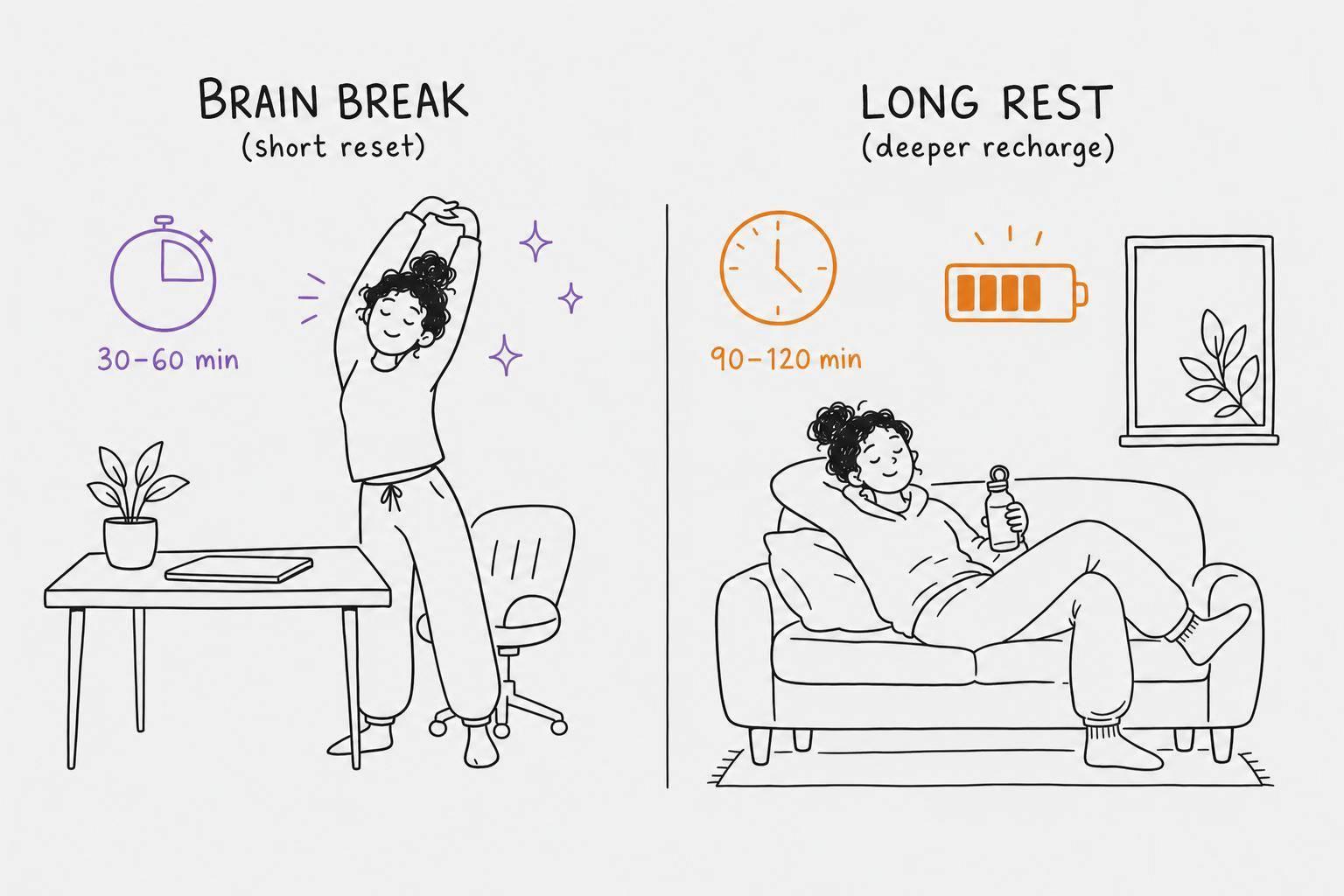
- A simple way to limit hyperfocus is to use 30–60 minute work blocks with alarms and movement breaks.
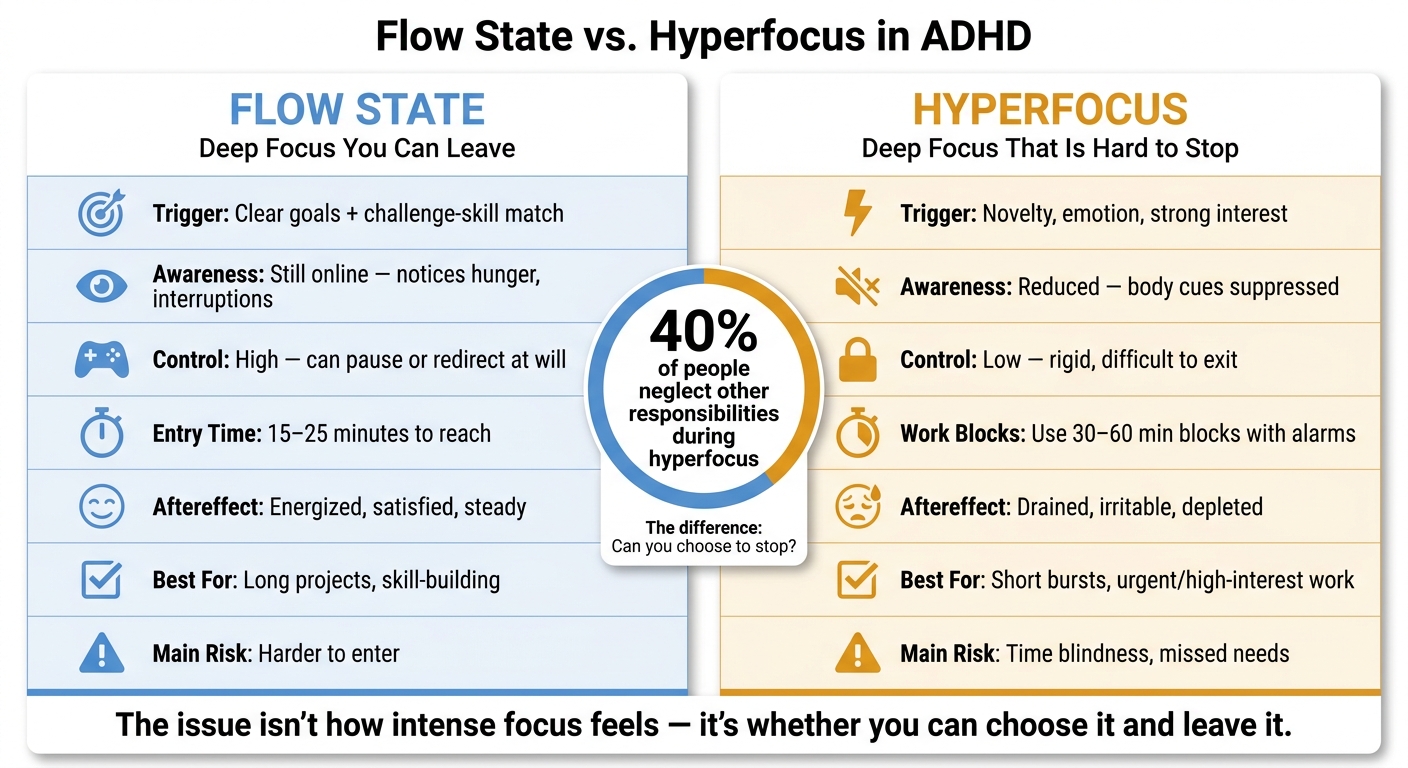
Flow State vs. Hyperfocus in ADHD: Key Differences at a Glance
Is "Flow" the same as hyper focus? | ADHD | Episode 72
sbb-itb-1b3be24
Quick Comparison
| Point | Flow | Hyperfocus |
|---|---|---|
| Main difference | I can step out of it | I get stuck in it |
| Common trigger | Clear goals + challenge-skill match | Novelty, emotion, strong interest |
| Body awareness | Still there | Often reduced |
| Task switching | Easier | Hard |
| Aftereffect | More steady, satisfied | More tired, irritable, depleted |
| Best use | Long projects, skill-building | Short bursts, urgent or high-interest work |
| Main risk | Hard to get into | Time blindness and missed needs |
If I had to sum up the whole piece in one line, it would be this: the issue is not how intense focus feels, but whether I can choose it and leave it when I need to.
What Flow State and Hyperfocus Look Like in ADHD
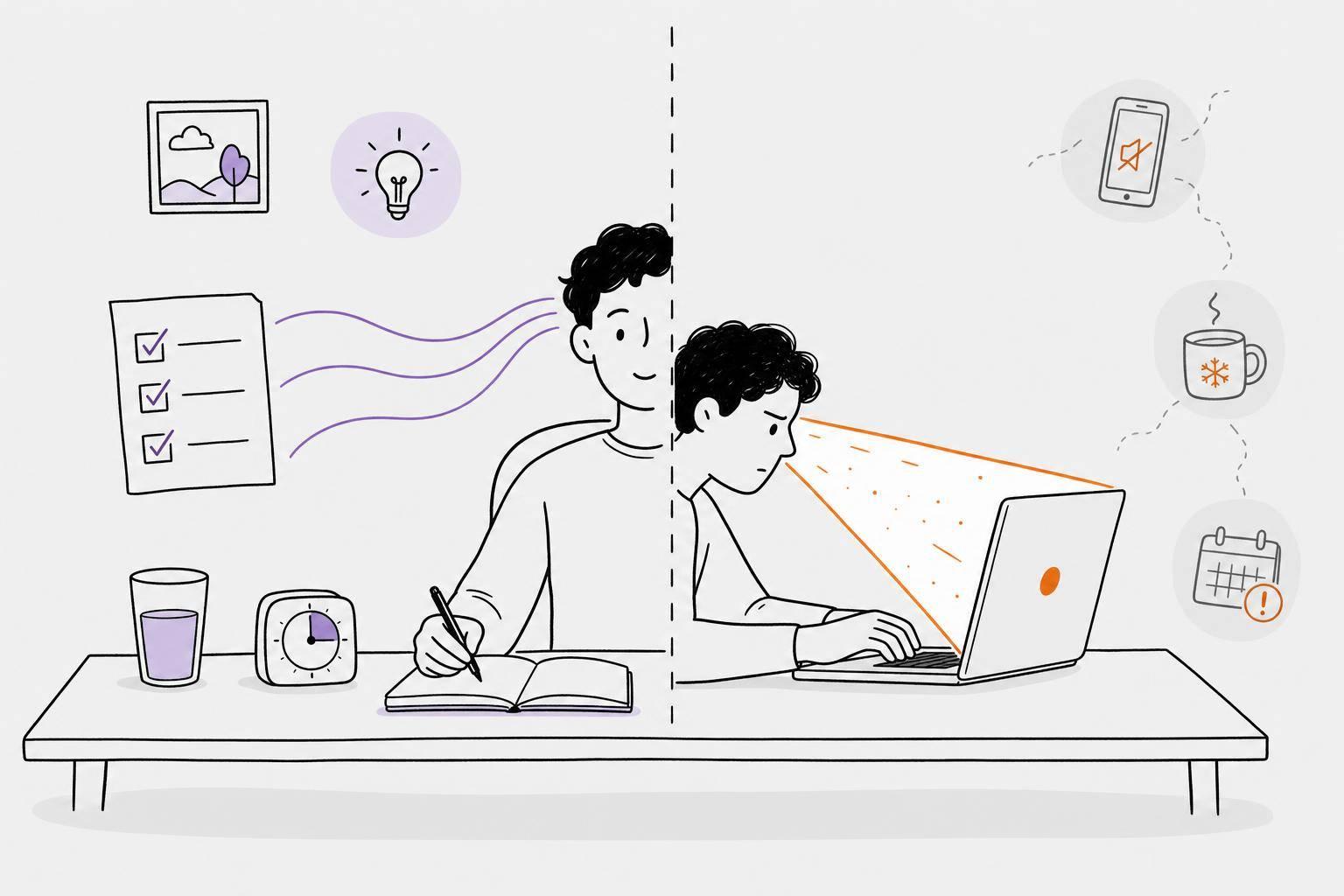
The easiest way to tell them apart isn’t intensity. It’s how much awareness and control you still have.
Flow State: Deep Focus You Can Still Step Out Of
Flow is deep focus with your awareness still online. Work feels smooth, your inner critic quiets down, and you’re fully in the moment. Sharon Saline, Psy.D., puts it this way:
"When you are in a flow state, you're moving and you're grooving, but you're not so zoomed into a task that you're unaware of where you are."
You still notice when you’re hungry, when someone interrupts you, and when it’s time to stop. That’s a big clue. In flow, you’re focused, but you’re not cut off from yourself or your surroundings.
When flow ends, people often feel energized and satisfied. It tends to show up when skill and challenge are in balance. Writing, coding, and other work with clear goals and fast feedback are common triggers. Research suggests it takes about 15 to 25 minutes of uninterrupted engagement to get there. In flow, focus stays steady. In hyperfocus, it starts to tighten.
When that balance shifts, the same deep focus can get a lot harder to leave.
Hyperfocus: Intense Attention That Is Hard to Exit
Hyperfocus is intense attention with a weak off-ramp. The outside world starts to fade. One of the clearest signs is missing body cues like hunger, thirst, or the need to use the bathroom. That’s often the point where flow crosses into hyperfocus. With ADHD, attention can latch onto immediate reward and have trouble letting go.
Hyperfocus isn’t always a bad thing. It can lead to bursts of output or strong creative work. But there’s a cost. About 40% report neglecting other responsibilities while in that state, often because they lack ADHD task management apps designed for their brain type. And when it ends, the crash can hit hard. Exhaustion or a sudden interruption may leave you irritable and drained.
Flow State vs. Hyperfocus: Key Differences
The main difference comes down to one thing: can you shift your attention when you need to? Once you look at awareness, control, and recovery, the gap between flow and hyperfocus gets pretty clear.
Awareness, Control, and Ability to Shift
In flow, your awareness stays online. You still notice your surroundings and body cues, and you can stop or switch gears if something more urgent shows up. The focus is deep, but you’re still driving.
Hyperfocus is different. Your attention locks onto one thing, and pulling away gets tough. Signals like thirst, hunger, or the need to use the bathroom may get screened out completely. You might get a lot done, but once hyperfocus takes over, it’s much harder to interrupt or steer in a new direction.
Here’s the fastest way to compare them:
| Feature | Flow State | Hyperfocus |
|---|---|---|
| Trigger | Challenge-skill balance, clear goals | Novelty, emotional intensity, or high interest |
| Awareness | Aware of surroundings and body cues | Total absorption; physical cues suppressed |
| Control | High; can pause or redirect at will | Low; rigid and difficult to exit |
Emotional Aftereffects, Triggers, and Long-Term Costs
The next piece is what each state leaves behind after it ends.
Flow usually leaves you feeling satisfied and ready for the next thing. It’s often triggered by a task that sits just beyond your current skill level. That small stretch keeps your brain engaged without pushing you into overload.
Hyperfocus, on the other hand, often starts with novelty or emotional intensity. And when it ends, the comedown can be rough.
"Hyperfocusing for long periods can cause stress reactions. Forgetting to eat, sleep, and hydrate causes people to become irritable because they are running on fumes." - Sharon Saline, Psy.D.
A long stretch of hyperfocus can leave you depleted, irritable, and drained. That matters when you’re deciding which state fits the job in front of you.
Benefits, Risks, and Best Uses for Each State
Flow and hyperfocus aren't good or bad on their own. What matters is fit. The better question isn't which one is more powerful. It's which one matches the work in front of you.
When Flow Supports Steady, Long-Term Progress
Flow is easier to keep up over time, so it tends to work better for longer projects. For people with ADHD, the hard part is often getting into it at all. One simple fix is to plan your day with ADHD by breaking a big project into smaller parts. That can make the task feel challenging enough to hold attention, without tipping into overload.
When Hyperfocus Helps and When It Costs Too Much
Hyperfocus can drive a lot of output in a short window. But there's a trade-off: it can push basic responsibilities to the side. The upside is speed. The downside is overdoing it and paying for it later. Hyperfocus makes sense for high-value work, but it can create problems when other demands are pulling at the same time.
In plain terms, the choice depends on the kind of output you need, the risk involved, and how much control the task calls for.
| Flow State | Hyperfocus | |
|---|---|---|
| Best for | Skill-building, steady projects | Complex bursts, creative sprints |
| Main risk | Harder to enter | Time blindness, crash |
Once you know which state fits the task, you can shape your environment and aim for it on purpose.
How to Use Flow and Hyperfocus on Purpose
Knowing the gap between flow and hyperfocus is only part of it. The other part is setting up your day so you can get into the state you need, when you need it. For flow, lower friction. For hyperfocus, add clear stopping cues.
Set Up Your Environment for Flow
Start by cutting friction, the effort it takes to begin a task and stick with it. Silence notifications before you start, put your phone in another room, and use white noise or instrumental music to cover distractions. Flow works best when attention stays steady without losing track of time, basic needs, or interruptions.
It also helps to match the task to your current skill level. Research points to the 4% rule: flow tends to happen when a task is about 4% past your comfort zone. If the task is too easy, your mind wanders. If it is too hard, you stall. Breaking a big project into smaller subtasks keeps each step in that sweet spot, and finishing each one gives your brain the feedback it needs to stay locked in.
There is one more window worth protecting: the first 15–25 minutes. For ADHD focus, that stretch is often the easiest to lose. Once you get going, set a recurring alarm every 45–60 minutes as a check-in point. The goal is not to stop. It is to ask yourself: Am I still on task? Have I eaten? Is anything urgent being ignored?
"Flow is what happens when the ADHD brain finally gets what it's been starving for." - AJ Keller, CEO, Neurosity
When deep focus helps but becomes hard to leave, it is time to shift from flow setup to containment.
Contain Hyperfocus and Track Patterns With Calma
Hyperfocus needs outside limits because it is hardest to stop from the inside. It can show up out of nowhere, so the best move is to put those limits in place before you begin.
Since hyperfocus narrows awareness, build a stop signal into the session from the start. Use time containers with a clear beginning and end, ideally 30–60 minutes for high-intensity work. When the alarm goes off, stand up or move around to break the lock-in. Before stepping away, leave yourself a quick note on where you stopped and what to do next. That makes it easier to pause without feeling like you will lose your place. Saying the shift out loud can help too: "I'm stopping this now to make lunch" gives your brain a plain signal to switch gears.
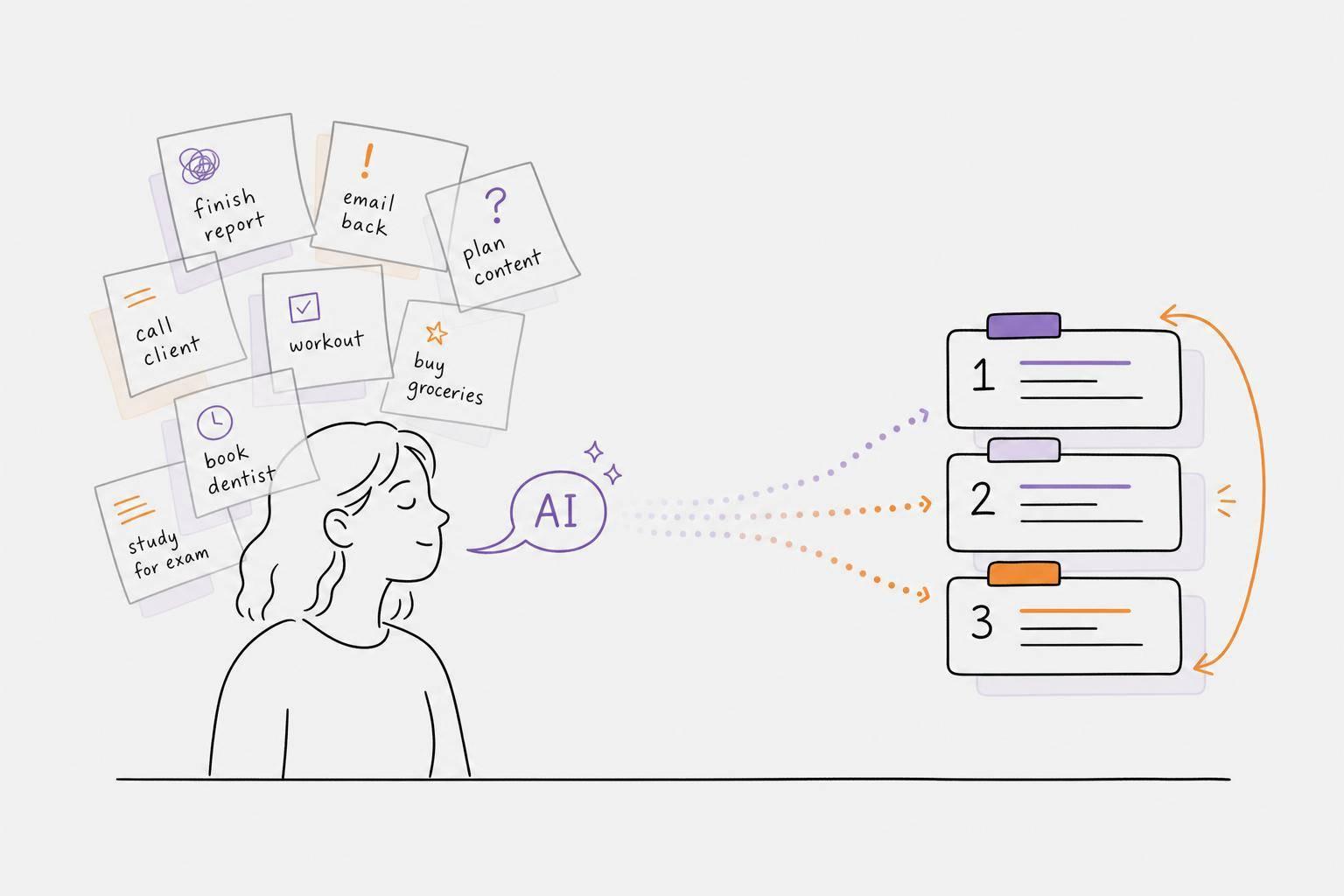
Calma can help here. It turns voice notes into prioritized tasks, tracks mood and habits, and helps you notice when deep focus is starting to slide into a hyperfocus spiral. Calma is available for $2/week or $39.99/year.
"Healthy attention isn't defined by how intense it is, or how long it lasts. It's defined by choice and release." - Dr. Anita Goraya, CBT/ADHD Therapist
Conclusion: Pick the Right Attention State for the Task
Flow is something you can steer. Hyperfocus is much harder to steer once it kicks in.
Use flow for steady projects that need calm, even effort. Use hyperfocus in short bursts for urgent work or tasks that naturally pull you in - but set stop cues first.
Once you know which state fits the job, the next move is simple: track what pulls you into each one using an ADHD productivity planner app.
The goal isn’t intensity for its own sake. It’s getting into the right state for the task and knowing when to stop.
Track which tasks trigger flow or hyperfocus in Calma so you can repeat what helps and limit what leaves you drained.
FAQs
Can flow become hyperfocus?
Not usually. Some people treat them as similar, but flow and hyperfocus are generally seen as different states.
Flow tends to be more intentional. You can get deeply absorbed in what you're doing, but it's usually easier to step away when needed. Hyperfocus is more involuntary and harder to stop. It can make you lose track of time or ignore basic needs like eating, resting, or taking breaks.
Is hyperfocus always bad in ADHD?
No. Hyperfocus can be a real strength when you aim it at work that matters or tasks that are hard to start. It can help you go deep, stay locked in, and get a lot done.
The trouble starts when it doesn't feel like a choice. You might miss responsibilities, skip meals or sleep, and lose track of time. Unlike flow, hyperfocus often doesn't let you shift gears easily, and that can lead to burnout.
How can I tell which one I’m in?
The main difference comes down to control.
Flow is a state of deep engagement that you can usually enter and leave on purpose. It tends to happen when the challenge in front of you lines up well with your skill level.
Hyperfocus is less voluntary. You get stuck on a task and may have a hard time pulling away, even when you want to stop. A simple gut check helps here: if you can shift your attention when needed, it’s probably flow.