Best AI Journaling Apps Compared in 2026

AI journaling apps in 2026 offer advanced tools that go beyond simple note-taking. They analyze emotions, track habits, and even convert voice inputs into tasks. Whether you're managing ADHD, seeking emotional clarity, or aiming to build consistent habits, there's a journaling app for you. Here's a quick breakdown of the top options:
- Calma: Designed for ADHD users, it simplifies journaling with voice-to-task conversion, emotion tracking, and habit visualization. Starts at $39.99/year.
- Rosebud: Acts like a mentor with personalized follow-up questions and mood tracking. Premium plans cost $12.99/month or $107.99/year.
- Life Note: Combines journaling with insights from historical thinkers, offering actionable steps and emotional analysis. $9.99/month or $79.99/year.
- Reflection: Features guided prompts and real-time AI coaching to deepen self-awareness. Pricing ranges from $5.75–$9.99/month.
- Stoic: Inspired by Stoic philosophy, it focuses on mindfulness with mood tracking and privacy-first design. Costs $6.99/month or $39.96/year.
Quick Comparison
| App | Key Features | Price (Annual) | Ideal For |
|---|---|---|---|
| Calma | Voice-to-task, emotion tracking | $39.99/year | ADHD users, task organization |
| Rosebud | Follow-up prompts, mood tracking | $107.99/year | Emotional clarity, mentoring |
| Life Note | Historical insights, goal setting | $79.99/year | Philosophical reflection |
| Reflection | AI coaching, guided prompts | $69.99/year (avg.) | Structured self-awareness |
| Stoic | Privacy-focused, mindfulness tools | $39.96/year | Budget-conscious users |
Each app caters to different needs, so choose based on your goals - whether it's simplifying tasks, exploring emotions, or building habits.
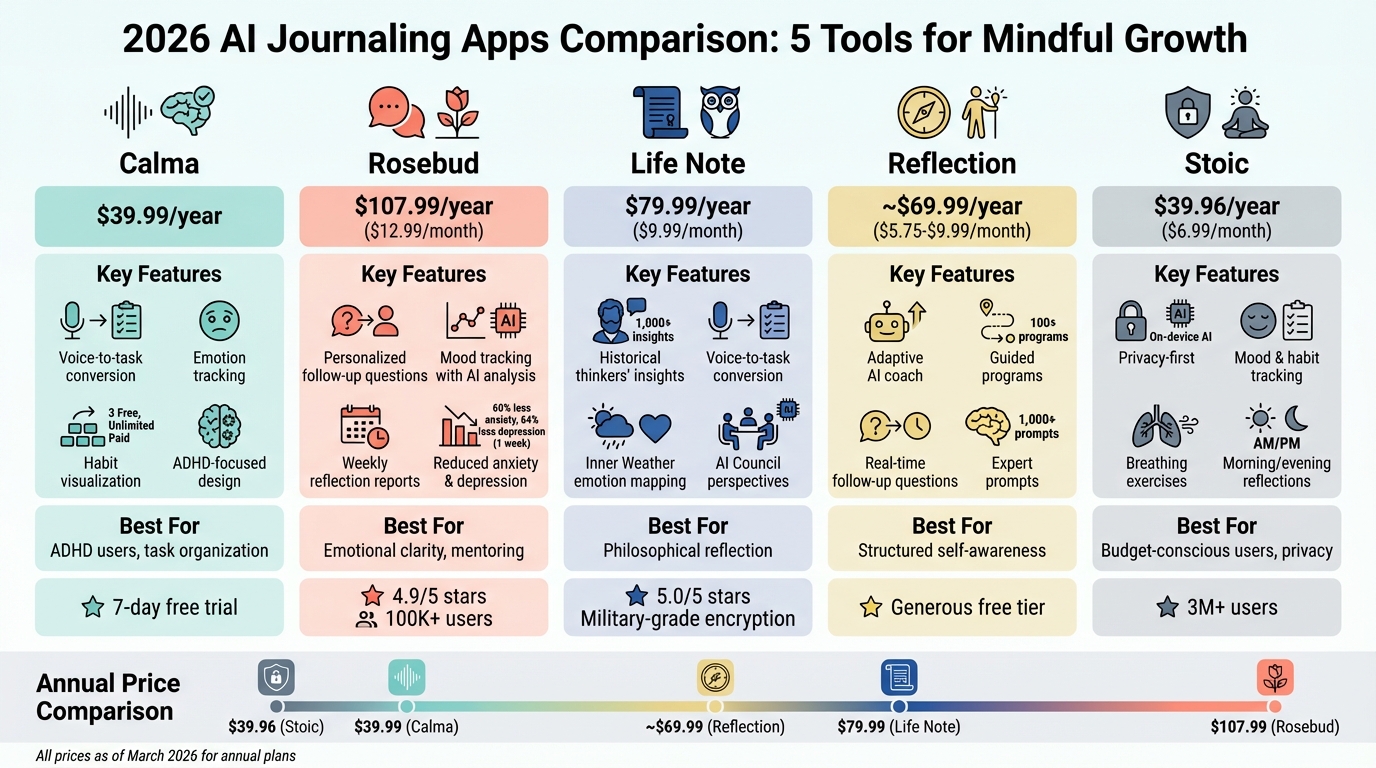
AI Journaling Apps 2026: Features and Pricing Comparison
1. Calma
Calma is an AI-powered planner designed for individuals with ADHD and anyone facing challenges with executive function. Its main goal is to lighten mental effort by prioritizing voice input, making idea capture feel effortless and natural.
Voice-to-Task Conversion
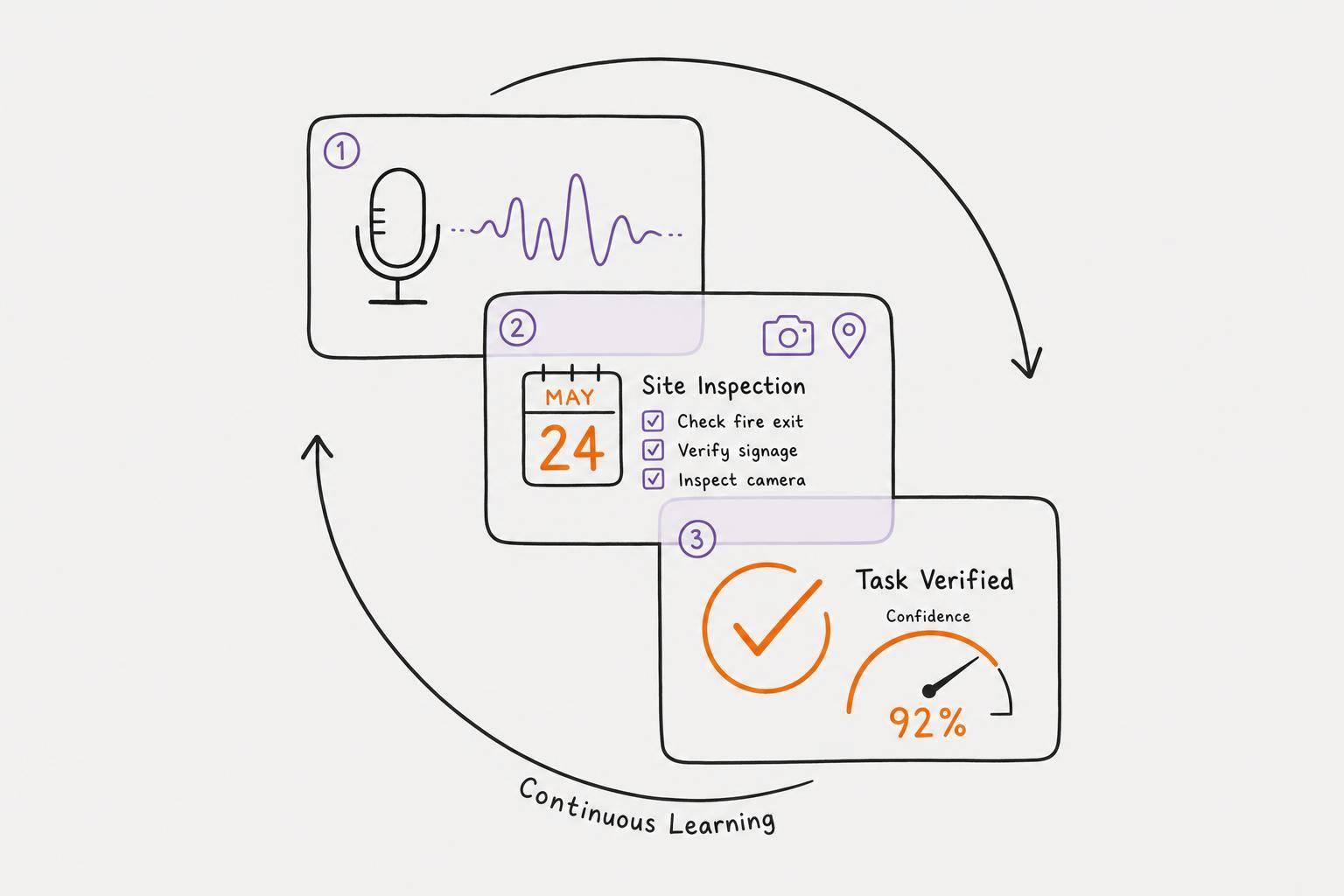
One of Calma's standout features is its voice-to-task conversion. This tool transforms your spoken thoughts into organized, prioritized tasks within seconds. The app’s AI identifies actionable items, assigns priorities, and even detects due dates automatically. While jotting down a thought in a traditional journal might take nearly a minute, Calma streamlines this process to just 10–15 seconds. Beyond organizing tasks, the app also encourages deeper self-awareness.
Mood and Emotion Tracking
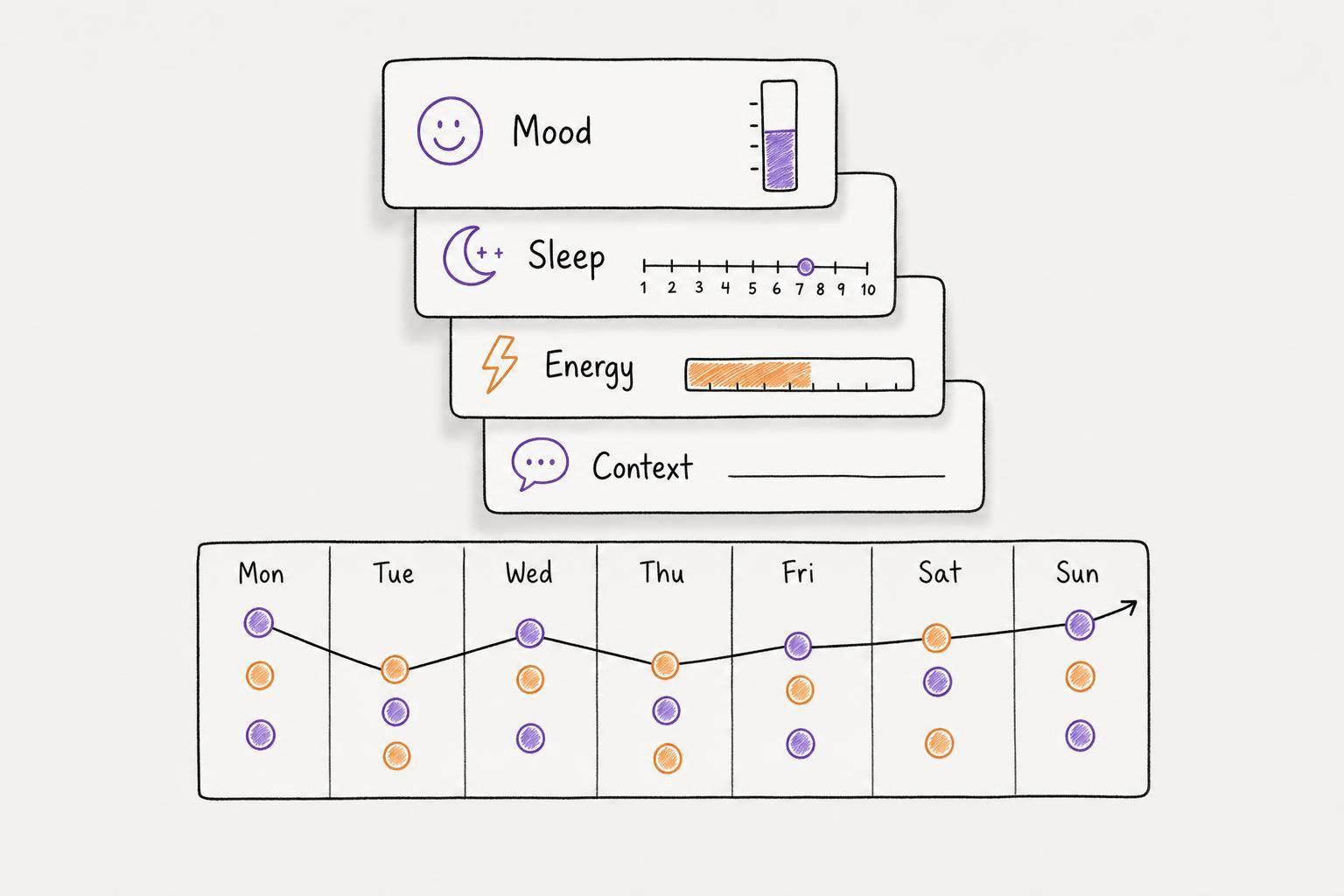
Calma doesn’t stop at task management - it also includes automatic emotion detection in its voice journals. As you record your thoughts, the app analyzes your tone to track emotional states and identify mood patterns over time. For instance, you might notice trends like feeling anxious on specific days or more energized after certain activities. The daily evening review feature prompts you to reflect on your day, helping establish a habit of regular self-check-ins.
Habit Tracking and Visualization
Calma uses visual habit progress grids to provide instant feedback and reinforce routines. On the free plan, you can track up to 3 habits, while the Pro plan offers unlimited tracking. The app also includes handy habit widgets for your home screen and a Sleep Check-In feature to monitor sleep quality, helping you uncover patterns that might impact your rest. These tools work together to create a structured yet flexible experience.
Pricing and Subscription Plans
Calma includes a 7-day grace period, giving you full access to its voice AI features at no cost. After the trial, the free plan allows manual task creation and tracking for up to 3 habits but excludes voice-to-task and voice-to-journal AI processing. For expanded functionality, the Pro Weekly plan costs $2.00/week, while the Pro Annual plan is $39.99/year. These Pro options unlock features like voice AI, calendar integration, iOS widgets, and unlimited habit tracking.
sbb-itb-1b3be24
2. Rosebud
Rosebud transforms AI journaling into a conversation, acting more like a supportive mentor than just a tool for jotting down thoughts. By asking thoughtful follow-up questions tailored to your entries, it encourages you to dig deeper into your emotions and thought patterns. This interactive approach seamlessly integrates with its robust tracking and reporting features.
Mood and Emotion Tracking
Rosebud takes self-reflection to the next level with its smart tracking capabilities. One of its standout features is its ability to analyze emotional patterns over time, identifying recurring themes, triggers, and behaviors. Thanks to its long-term memory, the app connects insights from past entries to provide personalized, context-aware feedback. Many users have praised its ability to uncover hidden worries and patterns, describing its insights as almost uncanny.
The app also generates weekly reflection reports that visually map your emotional progress. These reports highlight trends, and studies show that 60% of users report reduced anxiety symptoms, while 64% notice a decrease in depression symptoms after just one week of consistent journaling.
Habit Tracking and Visualization
Rosebud doesn’t stop at emotional insights - it helps turn them into action. The app identifies actionable takeaways from your journal entries and converts them into checklists, making it easier to translate reflections into real-world steps. Weekly reports and monthly summaries track your progress toward goals, while visualizing emotional trends over time. Features like habit streaks and smart reminders keep you on track, while the app monitors stress and joy triggers to help you fine-tune your routines.
Pricing and Subscription Plans
Rosebud offers a free plan that includes basic prompts, daily check-ins, and weekly summaries. For users seeking more advanced tools like long-term memory and voice transcription, the premium "Bloom" plan costs $12.99 per month or $107.99 annually (about $8.99/month), providing a roughly 30% discount for yearly subscribers. A 7-day free trial is also available for the premium plan. With over 100,000 users and a stellar 4.9/5 rating on the App Store from around 2,700 reviews, Rosebud has earned a strong reputation for helping users build self-awareness.
3. Life Note

Life Note blends timeless philosophical wisdom with cutting-edge productivity tools to create a unique experience. Drawing inspiration from over 1,000 historical thinkers, including Marcus Aurelius, Carl Jung, and Viktor Frankl, it offers personalized guidance aimed at improving productivity and mental clarity. Let’s dive into how Life Note turns your thoughts into actionable steps.
Voice-to-Task Conversion
The Journal With Voice feature allows you to dictate your thoughts anytime, anywhere, seamlessly transcribing them into written entries. Through the Aligned Actions system, these voice entries are analyzed to extract insights and convert them into specific, actionable steps [20, 22]. This feature bridges the gap between self-reflection and tangible progress, transforming emotional awareness into real-world actions.
Mood and Emotion Tracking
The Inner Weather feature maps your emotional patterns over time, helping you recognize triggers and adjust your responses. By analyzing your language, the app identifies and labels emotions - a method linked to reducing amygdala activity by up to 50%. Recurring themes and mindset shifts are cataloged in a searchable Wisdom Library [20, 21]. Additionally, the Inner Portrait Gallery transforms weekly journal patterns into symbolic visual art, offering a creative lens to reflect on your psychological growth [20, 22]. These emotional insights feed directly into goal-setting and planning.
Habit Tracking and Visualization
Life Note’s Goal Planning feature combines AI mentorship with progress tracking, while Goal Visualization employs guided mental imagery to bolster your intentions. Weekly Mentor Letters summarize your reflections, paired with AI-generated artwork inspired by your entries [2, 17]. The AI Council brings multiple historical perspectives to your journaling, offering diverse frameworks for tackling personal challenges [2, 17]. Licensed psychotherapist Sergio Rodriguez Castillo praises the app, saying:
"Most AI journaling apps feel like chatbots that flatter you. Life Note balances empathy and challenge - gentle nudges, thoughtful invitations, and wisdom from many fields".
Pricing and Subscription Plans
Life Note provides a free tier with basic journaling and AI mentor access, though it limits entries and lacks advanced personalization [24, 25]. The premium plan is priced at $9.99 per month or $79.99 annually, as verified in March 2026. Premium features include unlimited usage, Lifetime Memories for enhanced mentor recall, the AI Council, and even the ability to interact with your past self [2, 17]. With a flawless 5.0/5 rating on the App Store and military-grade AES-GCM encryption ensuring privacy, Life Note stands out as an affordable, in-depth journaling solution for those seeking more than surface-level prompts.
4. Reflection

Reflection is an AI-powered journaling app that combines thought recording with an adaptive AI coach. This coach engages you with real-time follow-up questions designed to deepen your self-awareness. Like other top journaling apps, Reflection turns everyday thoughts into opportunities for personal growth. But what really sets it apart is its focus on mood tracking and habit visualization.
Mood and Emotion Tracking
Reflection goes beyond simple mood logging. The app's AI analyzes your journal entries to uncover key themes, triggers, and behaviors. With its Progress Insights feature, you’ll get weekly and monthly reports that reveal patterns in your emotional and mental state. These insights include summaries of recurring triggers and themes, helping you understand what impacts your mood the most. Plus, you can rediscover past moments using natural language searches like “times I felt proud last year,” making it easier to reflect on your emotional journey.
Habit Tracking and Visualization
The app doesn’t stop at emotions - it also tracks habits. Using AI to spot patterns, Reflection provides visual progress reports that map your behaviors over time. Weekly and monthly updates help you see how your habits evolve. For added convenience, the voice-to-text feature simplifies journaling, especially for users with ADHD.
Pricing and Subscription Plans
Reflection also includes access to over 1,000 expert-designed prompts and more than 100 guided programs created by wellness professionals. This makes it a solid choice for anyone wanting structured therapeutic tools alongside AI-driven insights. Widely regarded as one of the leading journaling apps of 2026, Reflection blends advanced AI features with professional-grade wellness content. Pricing depends on the subscription tier and the features you choose.
5. Stoic

Stoic draws inspiration from Stoic philosophy, blending daily reflections with insights from ancient thinkers like Marcus Aurelius and Seneca. As of March 2026, the app boasts over 3 million users. A standout feature is its privacy-first design, with all AI processing happening directly on your device. This ensures your journal entries remain private while supporting the app's focus on mindfulness and security.
Mood and Emotion Tracking
Stoic uses AI to analyze your daily reflections through structured morning and evening check-ins. The Trends Tracking feature visualizes various metrics - such as mood, emotions, sleep, health, and writing habits - helping you pinpoint factors that influence your well-being. Alongside mood tracking, the app incorporates breathing exercises and meditation for a more complete mental health experience.
However, some users have found the AI's guidance to be somewhat repetitive over time. According to Life Note Blog:
"The AI guidance, while present, feels basic and repetitive, often rephrasing the same Stoic principles without adapting deeply to your unique situation."
Despite this, Stoic remains a useful tool for maintaining mental clarity and productivity.
Habit Tracking and Visualization
In addition to mood tracking, Stoic includes a comprehensive habit tracker. The evening habit tracker encourages reflection on your daily actions, while streak trackers and achievement badges help keep you motivated. To support focus, the app also features a tool that blocks distracting apps during work or study sessions.
Pricing and Subscription Plans
Stoic provides a free version with basic features. For those seeking more, the premium subscription costs $6.99 per month or $39.96 annually. This pricing is competitive compared to many other AI journaling apps. Stoic is accessible on iOS, iPadOS, macOS, Apple Watch, Android, and web platforms.
Strengths and Weaknesses
Drawing from the detailed app reviews above, this comparison focuses on how each tool's features translate into real-world benefits and limitations. Whether you're managing ADHD symptoms, exploring deeper philosophical insights, or simply trying to build a daily journaling habit on a budget, each app offers its own blend of strengths and trade-offs.
Here’s a quick breakdown of the key strengths and weaknesses for each app:
| App | Key Strengths | Notable Weaknesses |
|---|---|---|
| Calma | Voice-to-task and voice-to-journal features make it easier for ADHD users; mood tracking with emotion detection; visual progress grids; affordable at $39.99/year | Free plan is limited to only 3 habits; calendar integration and widgets require a paid plan |
| Rosebud | Conversational prompts designed by therapists help overcome writer's block; 500 million words journaled; weekly summaries highlight emotional patterns | AI responses can feel repetitive, following a validate → reframe → action loop; higher pricing at $12.99–$14.99/month |
| Life Note | AI mentor system inspired by 1,000+ historical figures offers deep insights; 84% of users cite "depth of responses" as their reason for switching; most affordable premium plan at $9.99/month | Focuses on depth, which might feel slow for quick journaling sessions |
| Reflection | Over 100 guided programs created by experts provide structure; real-time follow-up questions help avoid "blank page" moments; generous free tier with premium priced at $5.75–$9.99/month | AI tone sometimes feels generic, similar to standard chatbot interactions |
| Stoic | Privacy-focused with on-device AI processing; includes habit tracking and breathing exercises; lowest annual cost at roughly $30/year | Guidance can feel basic or repetitive with extended use; limited to Apple devices |
The pricing varies widely, from Stoic’s budget-friendly $30/year to Rosebud’s premium $14.99/month, reflecting the trade-off between cost and functionality. Reflection seems to strike a balance for many users, offering expert-designed guides and pattern recognition at a mid-range price. Features like voice-to-text, particularly useful for ADHD users, are available in apps like Calma, Rosebud, and Reflection. Ultimately, though, the key isn't which app you choose - it's about sticking to a consistent journaling routine.
Conclusion
When it comes to choosing the right journaling app, it all boils down to what suits your personal needs best. For those seeking ADHD productivity app options who find traditional typing challenging, Calma offers voice-to-task and voice-to-journal features for $39.99/year, making it easier to capture thoughts on the go. Similarly, Rosebud is a great option for users who prefer voice input.
If you're seeking emotional clarity and therapeutic tools, several apps stand out. Rosebud has been praised for helping users improve their mood significantly. Meanwhile, Reflection uses its Adaptive AI Coach to provide real-time follow-up questions, helping users uncover recurring emotional patterns. These tools are designed to dig deeper into emotional well-being, offering meaningful insights.
For those who thrive on structure, Calma provides visual progress grids and mood tracking to encourage consistency, while Stoic focuses on daily routines with features like morning intentions and evening reflections. If you're drawn to philosophical exploration, Life Note might be your pick - 84% of users who switched to it highlighted the "depth of AI responses" as a key factor.
Pricing varies, from Stoic's budget-friendly plans to Rosebud's premium tier, with plenty of mid-range options in between. Regardless of the app you choose, consistency is the real game-changer. Many users report noticeable improvements in emotional awareness within just two weeks of regular journaling. So, commit to the habit, and watch your productivity and clarity grow.
FAQs
How do I pick the right AI journaling app for my goals?
To pick the best AI journaling app, start by figuring out what matters most to you - whether it's better self-reflection, building a regular habit, personal growth, privacy, or sparking creative ideas. Prioritize apps that offer features like well-crafted prompts, strong privacy measures (like end-to-end encryption), and versatile input options (such as voice or text).
Also, consider whether the app supports your daily routine with tools like workflow integration, the ability to recognize patterns in your entries, and compatibility across devices. These factors can help ensure the app fits seamlessly into your life and supports your journaling goals.
Are my journal entries private and encrypted?
Most AI journaling apps take privacy seriously, often employing encryption to safeguard your entries. Some even go a step further by offering end-to-end encryption, ensuring that only you can access your data.
To make sure your information stays secure, it's a good idea to review the app's privacy policies. This way, you can understand exactly how your data is being handled and protected.
Can I use voice notes to create tasks and habits?
Many AI journaling apps now include the option to use voice notes for creating tasks and tracking habits. This feature makes it easy to capture your thoughts on the go and organize them seamlessly, helping you stay on top of your habits and tasks without much effort.