Daily Planning Checklist for ADHD Brains
ADHD brains often struggle with managing time, starting tasks, and switching focus. This checklist provides a simple system to make planning easier and reduce overwhelm. By externalizing tasks, prioritizing effectively, and creating flexible schedules, you can work with your brain’s tendencies rather than against them.
Here’s the core approach:
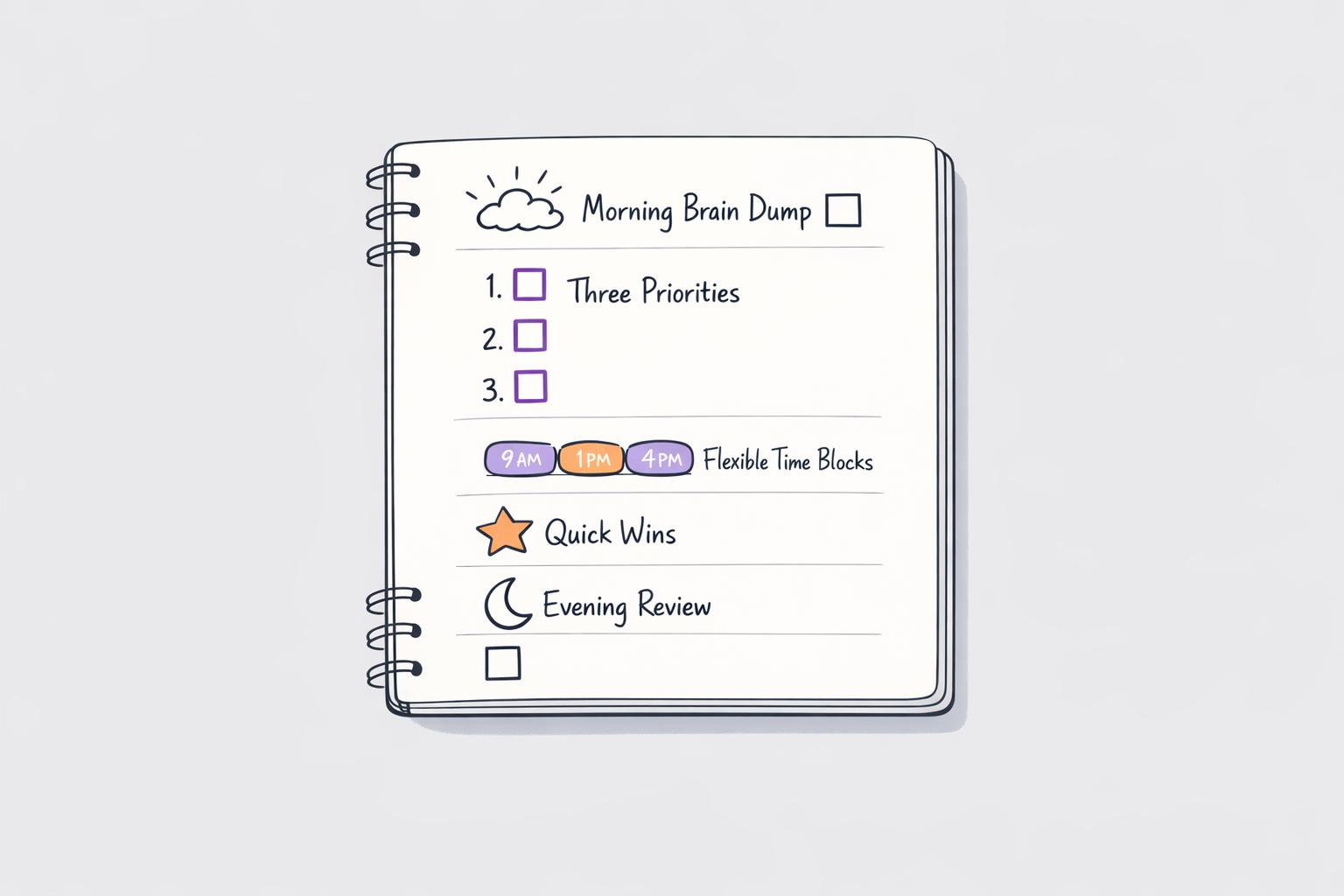
- Brain Dump in the Morning: Clear your mind by writing down everything, without judgment. Tools like voice-to-task apps can speed this up.
- Pick 3 Priorities: Focus on three tasks that will have the biggest impact. Use a traffic light system (Red = urgent, Yellow = important, Green = low-stakes) to prioritize.
- Flexible Time Blocks: Plan your day in chunks, leave buffers for unexpected delays, and schedule breaks to avoid burnout.
- Quick Wins & Habit Tracking: Start with small, 5-minute tasks to build momentum. Use trackers that emphasize progress, not perfection.
- Evening Review: Reflect on your day without self-criticism, celebrate wins, and prepare for tomorrow.
This system isn’t about perfection - it’s about creating days that are easier to reset, helping you move forward without guilt.
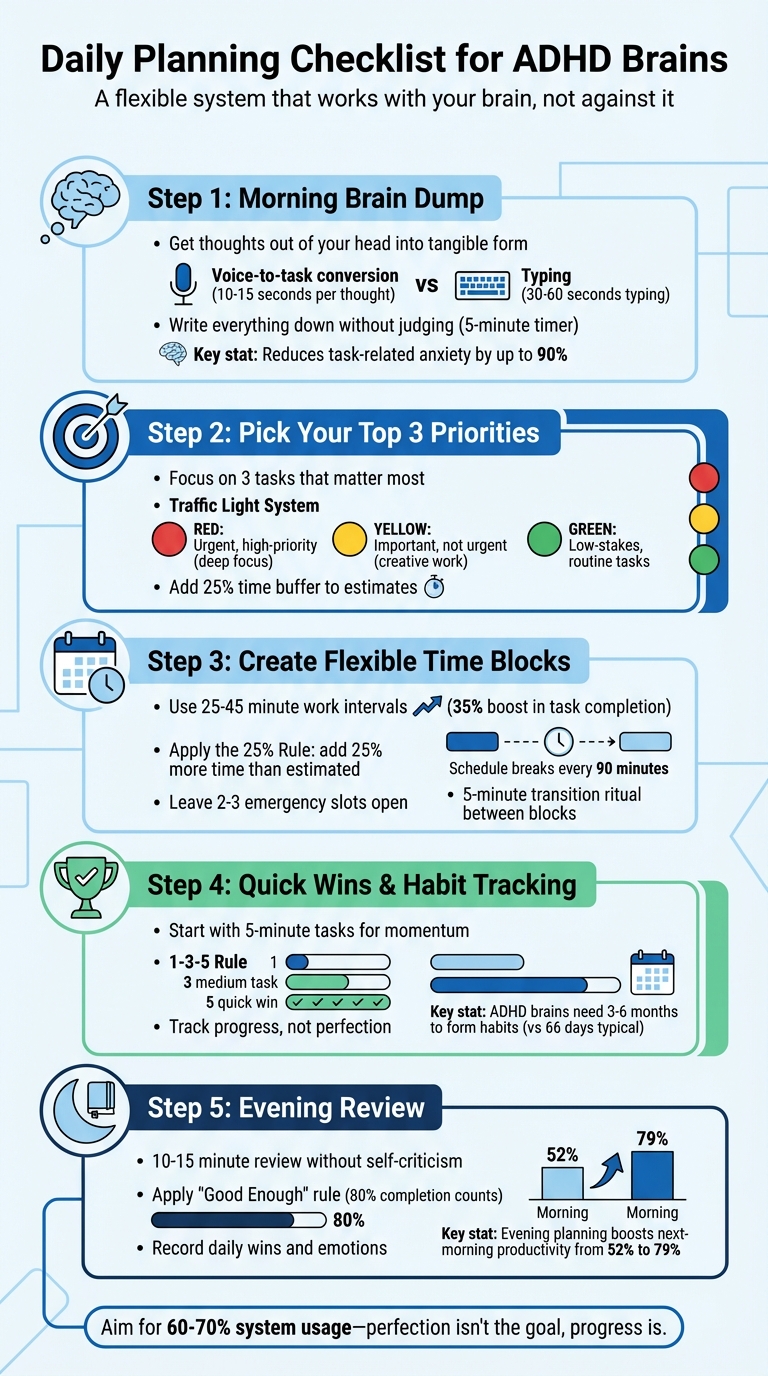
5-Step Daily Planning System for ADHD: Morning Brain Dump to Evening Review
How to actually stick to your plans with ADHD (it's not discipline)
Step 1: Do a Morning Brain Dump
If you have ADHD, mornings can feel like a whirlwind. Your brain wakes up juggling leftover tasks, nagging worries, and fresh ideas all at once. Research shows that ADHD brains often have 3–7% less volume in areas tied to executive function, which limits working memory capacity. The fix? Get those thoughts out of your head and into a tangible form.
A morning brain dump is all about clearing mental space. Studies suggest that using ADHD-specific systems to externalize tasks can slash task-related anxiety by up to 90%. By freeing up your mind, you make room to focus on what matters. Tools like voice-to-task conversion and unfiltered writing can help you capture these thoughts quickly and effectively.
Use Voice-to-Task Conversion
Sometimes, typing or writing feels like a hurdle - your thoughts race faster than your fingers can keep up. Voice capture eliminates this friction, letting you turn spoken words into structured tasks almost instantly.
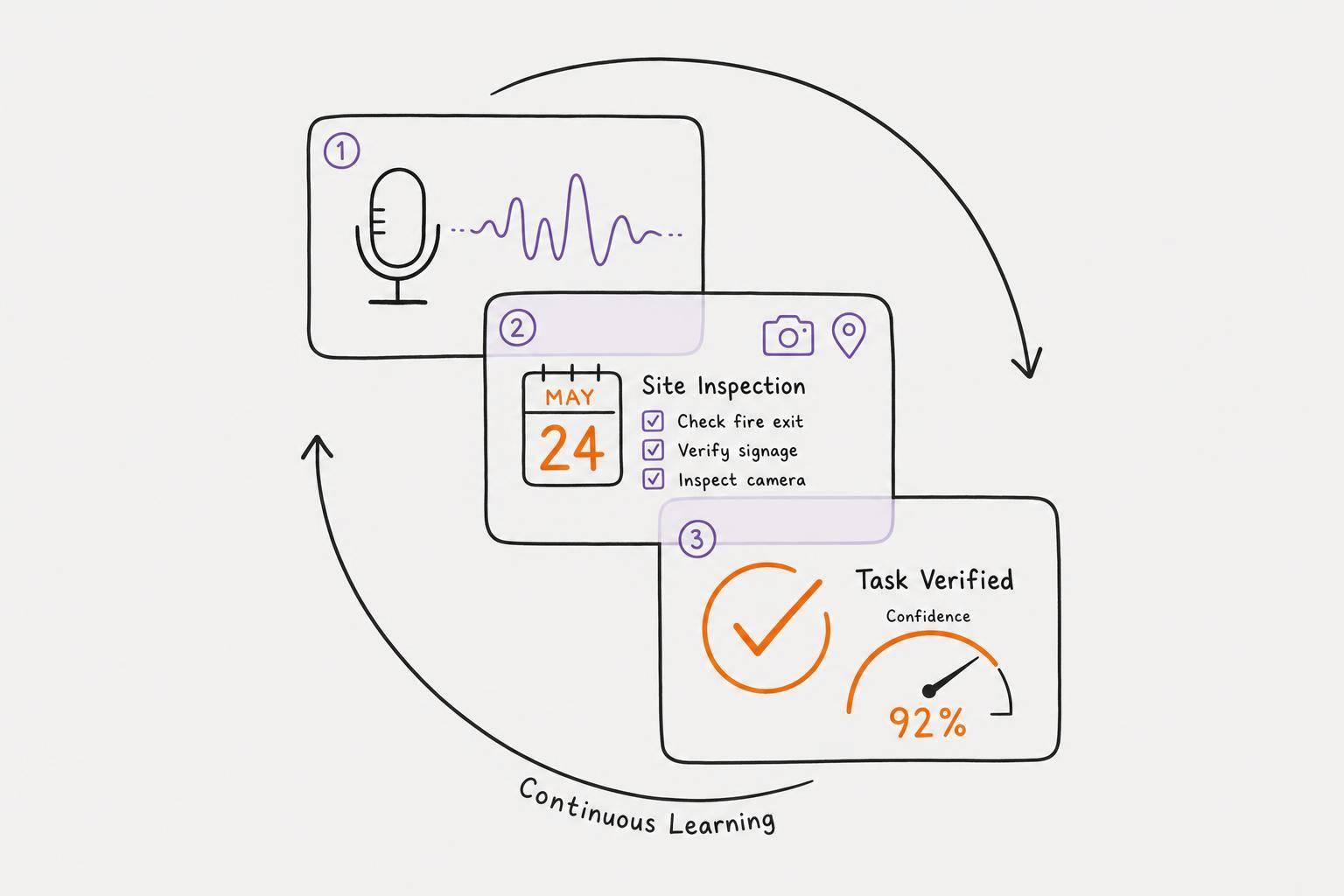
Take Calma's voice-to-task feature, for example. You can ramble through your thoughts, and it organizes them for you. Say something like, "Email Sarah about the project by Friday, pick up groceries, and call the dentist", and Calma extracts the tasks, identifies due dates, and prioritizes them. This process takes just 10–15 seconds per thought, compared to the 30–60 seconds you'd spend typing manually. It’s not about forcing your brain to slow down - it’s about keeping up with its natural pace. Once your thoughts are captured, the next step is to jot everything down without overthinking.
Write Everything Down Without Judging
One common pitfall during a brain dump is overanalyzing. You might wonder, "Is this task too minor to note? Does this even matter?" Suddenly, you're stuck evaluating instead of capturing. The goal here is to write it all down - every single thought, no matter how trivial it seems.
Set a timer for five minutes and let your thoughts spill out freely, without worrying about categories or priorities. Emotional clutter counts, too. Jotting down worries or feelings can stop them from taking over your focus later.
"The key to ADHD productivity isn't forcing yourself into neurotypical systems - it's finding approaches that harness your brain's unique strengths." - Dr. Russell Barkley
Once the clutter’s out of your head, you’re ready to take action. Your strength lies not in remembering everything but in clearing the path to move forward.
Step 2: Pick Your Top 3 Priorities
Now that you’ve captured all your thoughts, it’s time to zero in on your top three priorities. After your brain dump, narrow the list down to three tasks that matter the most. This method keeps you focused on meaningful accomplishments rather than drowning in an overwhelming to-do list. For people with ADHD, it’s easy to overestimate how much can be done in a single day, which can lead to frustration or even a "shame spiral" when tasks remain unfinished. By concentrating on three key tasks, you can work with your brain’s natural rhythm to achieve clear, actionable results.
Here’s a helpful question to guide you: Which task will bring the most relief or have the biggest impact if completed? This can help you identify tasks that carry serious consequences if ignored.
Use a Traffic Light System
Colors can simplify decision-making, especially when you’re prioritizing tasks. A traffic light system is a quick way to sort your to-dos:
- Red: High-priority tasks that require immediate attention or deep focus, like meeting deadlines or tackling complex projects.
- Yellow: Important tasks that aren’t as urgent, such as brainstorming or working on creative ideas.
- Green: Low-stakes, routine tasks, like answering emails, making phone calls, or running errands.
Once you’ve sorted your tasks by color, pick your top three priorities. Start with a Red task during your peak energy period, then use a Yellow or Green task as a "break" to keep yourself balanced and productive.
Plan for Time Blindness
Time blindness is a common hurdle for people with ADHD. It stems from differences in how the brain processes time, particularly in areas like the prefrontal cortex and basal ganglia. This can lead to underestimating how long tasks will take - not out of laziness, but because of how the brain is wired.
"Time blindness is the most devastating deficit in adult life that ADHD produces… a disruption in the fabric of time." – Russell Barkley, ADHD Researcher
To work around time blindness, adjust your time estimates. For example, if you think a task will take 30 minutes, multiply that by 1.5 or add a 25% buffer to your estimate.
Another helpful approach is backward planning. Start with your deadline, subtract the estimated time for the task (including buffers), and allocate 70–80% of your available time to planned activities. This ensures your top three priorities fit into your day without creating unrealistic expectations.
Step 3: Create a Flexible Time Block Schedule
Once you’ve identified your top three priorities, the next step is to create a schedule that works with your ADHD tendencies, not against them. Time blocks are a great tool, but think of them as flexible guides rather than rigid rules. The aim is to provide structure without making you feel trapped.
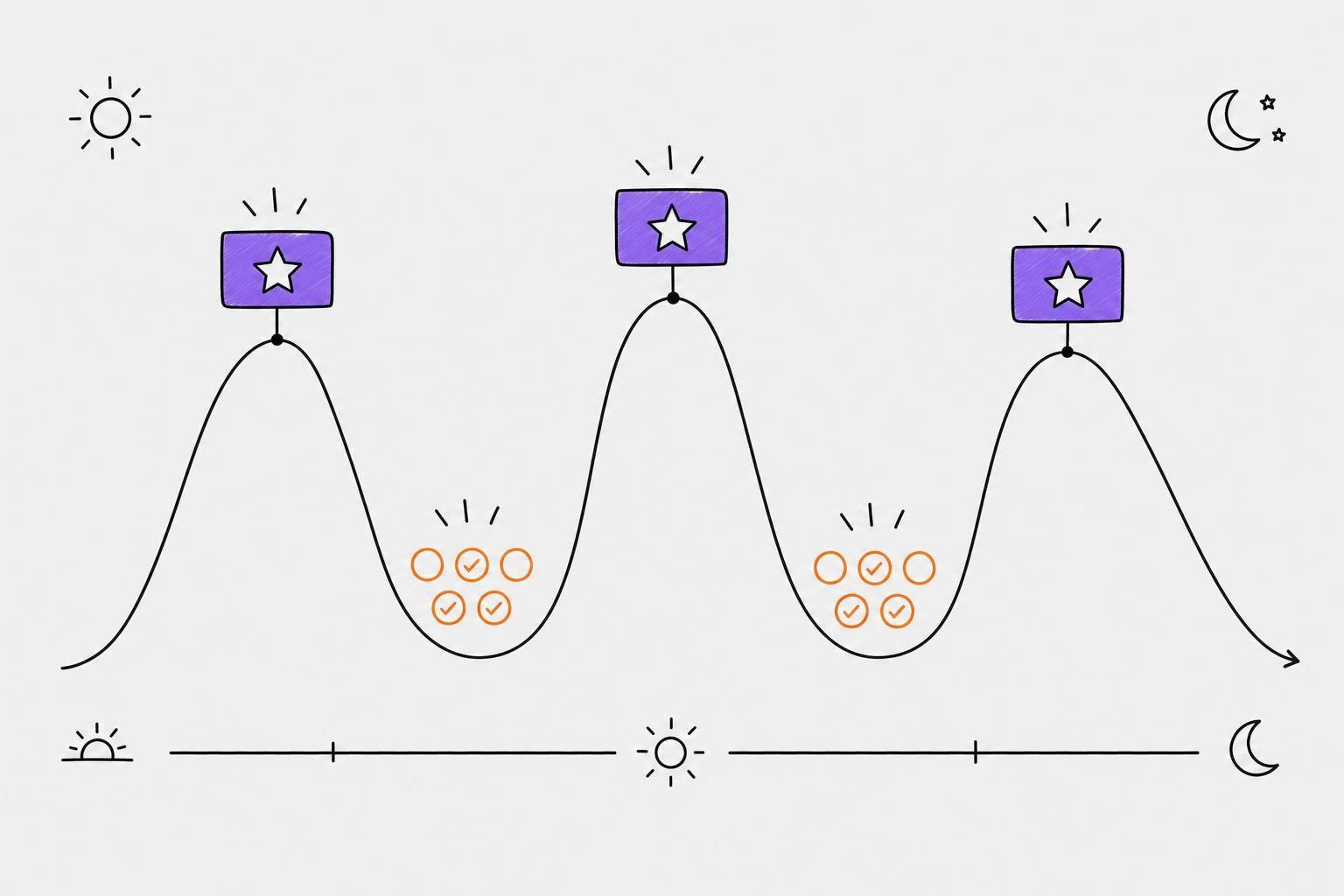
Start by organizing your schedule into broad categories. Instead of labeling a block with a specific task like "Email John about budget report", use general terms such as "Admin" or "Creative Work." This way, you can choose the most engaging or manageable task in the moment. Research shows that working within 25–45 minute intervals can lead to a 35% boost in task completion rates.
To make your schedule even more ADHD-friendly, apply the 25% Rule. For any task, add 25% more time than you think you’ll need. For example, if a task typically takes 40 minutes, block out 50 minutes. This buffer helps account for time blindness and prevents your schedule from running off track. Also, leave 2–3 blocks open as "emergency slots" to handle unexpected tasks or catch up if needed.
Color-coding your schedule can also make it more visually intuitive. For instance, use red for deep focus activities, purple for self-care, and white for buffer zones. Match your schedule to your natural energy patterns by tackling high-focus tasks during your peak productivity times (often 1–2 hours after taking medication) and saving lower-energy periods for simpler chores.
Finally, don’t forget to build in short breaks to maintain your momentum.
Schedule Movement and Breaks
Breaks are essential for recharging your focus. Plan "circuit breakers" every 90 minutes to prevent burnout, especially if you’re prone to hyperfocus. These breaks don’t have to be long - 5 minutes for hydration, stretching, or taking medication can do wonders for your body and mind.
Between time blocks, try a 5-minute transition ritual to smoothly shift gears:
- Minute 1: Save your work
- Minute 2: Clear your workspace
- Minute 3: Breathe or stretch
- Minute 4: Set up for your next task
- Minute 5: Review your goals
Adding 10–15 minute buffer zones between activities can also help your brain adjust without feeling rushed.
Set Up AI-Powered Reminders
AI tools like Calma can take the pain out of manual scheduling. By simply speaking your tasks or priorities aloud, Calma’s AI will extract deadlines, organize tasks, and set reminders for you. This reduces the mental effort of planning and helps you stay on track.
For crucial tasks, set multiple alerts - one 30 minutes before and another 10 minutes before. This approach supports backward planning, where you start with a fixed end time (say, a 6:00 PM dinner) and work backward to ensure you’ve accounted for preparation, travel, and buffer time. Calma’s automatic detection of deadlines and transitions makes this process seamless, so you don’t have to worry about missing anything important.
sbb-itb-1b3be24
Step 4: Use Quick Wins and Habit Tracking
Once you've structured your day, quick wins and habit tracking can help you maintain momentum and keep moving forward.
Momentum is especially important for ADHD brains because quick wins provide those much-needed bursts of dopamine. Research indicates that adults with ADHD need 40–50% more repetitions to form automatic habits compared to neurotypical individuals. While it typically takes 66 days for a habit to stick, ADHD brains may require 3–6 months to achieve the same result. Quick wins not only help build trust in your ability to follow through but also reduce the mental resistance that often leads to task paralysis.
Start with 5-Minute Tasks
Lower the entry barrier by starting with tasks that take just a few minutes. Instead of attempting something overwhelming like cleaning the entire kitchen, focus on placing three dishes in the dishwasher. If a 30-minute workout feels daunting, start by simply putting on your workout clothes. Small actions like these can make a big difference. For example:
- Drink a glass of water or open the curtains.
- Clear a single small area on your workspace.
- Send a short text to someone you care about.
- Open a document and write just one sentence.
The 1-3-5 Rule can be a game-changer: plan your day around 1 large project, 3 medium tasks, and 5 quick, easy wins. This strategy keeps your to-do list manageable and prevents the overwhelm that comes with trying to tackle everything at once.
While quick wins provide an initial boost, habit tracking ensures you stay on track over time.
Track Habits with Visual Grids
Traditional habit trackers often focus on maintaining perfect streaks, which can feel discouraging if you miss a day. For ADHD brains, a more forgiving approach works better. Instead of penalizing missed days, ADHD-friendly habit trackers celebrate overall progress. Studies show that adults with ADHD are three times more likely to stick with habits over six months when using flexible completion rates rather than rigid streak-based systems.
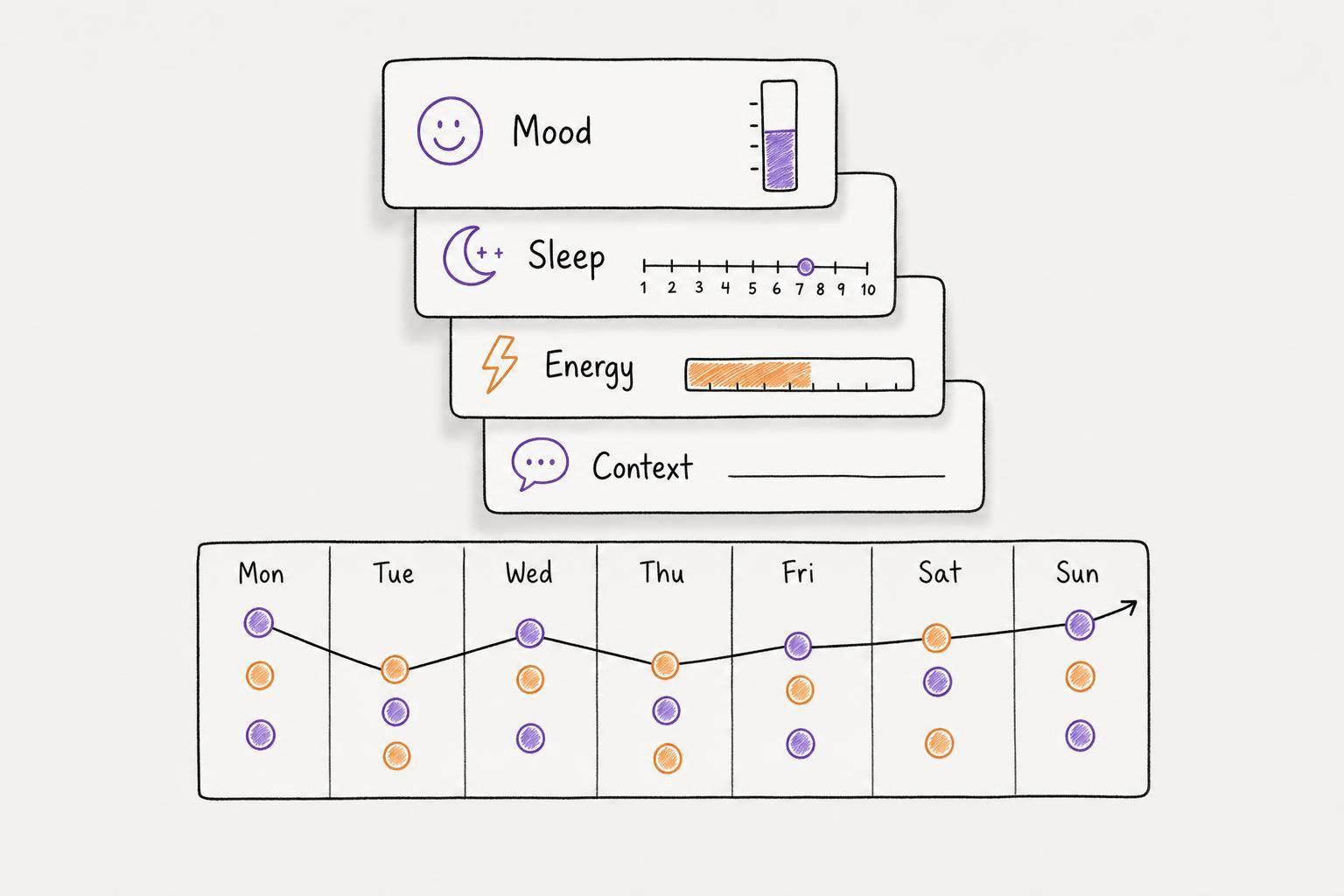
Calma's visual progress grids are a great example of this. These grids emphasize your overall completion rate - like finishing 5 out of 7 days - while offering immediate visual feedback and tracking your emotions. This method shifts the focus from perfection to resilience, encouraging you to bounce back even if you miss a day.
Additionally, track your effort, not just the final outcome. For instance, if you're interrupted but manage to return to the task, count that as a win. To reinforce habits, set up multiple reminders: one 5–10 minutes before the task to help you transition, and another at the task's start time. Combining quick wins with flexible habit tracking creates a system that works with your ADHD brain rather than against it.
Step 5: Do an Evening Review and Celebrate Wins
Wrapping up your day with a quick review can help you unwind and prepare for a more productive tomorrow. This simple habit clears your mind and reduces decision fatigue for the next morning. In fact, research found that identifying just three priority tasks each evening boosted next-morning productivity rates from 52% to 79% over three weeks. For individuals with ADHD - whose brains may have 3–7% less volume in areas tied to executive function - this added structure can be a game-changer. Think of this evening review as the final piece in your planning puzzle, setting a positive tone for the day ahead.
Review Your Day Without Self-Criticism
Keep your review short and consistent - 10 to 15 minutes is ideal. Start by spending 5 minutes jotting down any lingering thoughts in a journal or app to clear your mental space.
Next, apply the "Good Enough" rule. Instead of chasing perfection, evaluate your day based on progress. Did you complete 80% of a task? Did you manage to return to it after interruptions? That’s progress, and it counts.
"People waste energy and burn out, allowing their busy-ness to be driven by what's latest and loudest, hoping it's the right thing to do but never feeling the relief that it is." – David Allen
This review isn’t about reliving the day emotionally; it’s about clarifying what worked and what didn’t. By closing the loop on today, you set the stage for a smoother tomorrow, free of mental clutter.
End your review with a clear ritual that signals the day is over. This could be as simple as shutting your laptop, turning off a specific light, or changing into pajamas. Cal Newport calls this practice “Schedule shutdown complete”. These small actions help your brain shift gears, reducing the urge to dwell on unfinished tasks and easing you into rest mode.
Record Daily Wins and Emotions
Once you’ve reviewed your tasks, take a moment to celebrate your wins. Focus on your effort and progress rather than perfect outcomes. Did you manage to refocus after an interruption? Did you make headway on a challenging task? Acknowledge those moments of progress - they matter.
Tools like Calma’s voice-to-journal feature make this process simple. Just speak your thoughts, and the app will log your emotions and track your wins automatically. By reflecting on your successes and how they made you feel, you can identify what strategies work best for you. Celebrating small victories builds momentum and sets an encouraging tone for the next day.
Conclusion
Planning for ADHD isn't about squeezing yourself into systems designed for neurotypical minds. It's about crafting methods that align with how your brain naturally works. By following these steps - like brain dumps, prioritizing three key tasks, using flexible time blocks, tackling quick wins, and doing evening reviews - you can create a structure that supports executive function in a way that feels manageable and effective.
"The key to ADHD productivity isn't forcing yourself into neurotypical systems - it's finding approaches that harness your brain's unique strengths." - Dr. Russell Barkley, ADHD Research Pioneer
Start small. Try out one or two strategies and stick with them for a couple of weeks. Pair your new planning habit with something you already do, like reviewing your planner during your morning coffee. The aim isn't flawless execution; it's about creating days that are easy to recover when things go off track. Using your system 60-70% of the time is enough, and if you miss a day, just jump back in without guilt.
Tools like Calma, with its voice-to-task conversion and AI-driven features, help lighten the mental load that traditional planning methods can bring. It offers support without piling on complexity.
Small adjustments can create momentum. You're not reinventing your life overnight - you're building a framework to make each day a little easier. Start using this checklist today to lean into your brain's strengths and simplify your planning.
FAQs
What if I can’t narrow it down to just 3 priorities?
If picking just three priorities feels like too much, start with one key task that needs your attention right now. You can also group similar tasks into broader categories or focus on the two or three items that will make the biggest difference. The aim isn’t to get everything perfect - it’s about moving forward. Simple, flexible strategies and tools can help you figure out what truly matters, without feeling boxed in by strict rules.
How do I time-block when my day keeps changing?
To make time-blocking work with a shifting schedule, try creating a plan that's both flexible and easy to adjust. Start by pinpointing your peak focus hours - those times when you're naturally more productive - so you can tackle high-priority tasks then. Use visual aids like color-coded blocks or timers to organize your day, making it easier to see what’s next at a glance. Don’t forget to add buffer time between tasks to handle unexpected changes or delays.
It’s also a good idea to regularly revisit your priorities and tweak your plan as needed. Setting reminders can help you stay on track without feeling overwhelmed. This method keeps your schedule manageable while allowing room for adjustments.
What’s the fastest way to restart after I fall off the plan?
The fastest way to get back on track is to keep things simple and take small, easy steps. Begin with just one task - maybe reviewing your priorities or setting a straightforward goal. Tools like reminders or apps designed for ADHD can help you stay organized. Don’t try to change everything all at once - instead, focus on small actions that help you rebuild your routine bit by bit.